
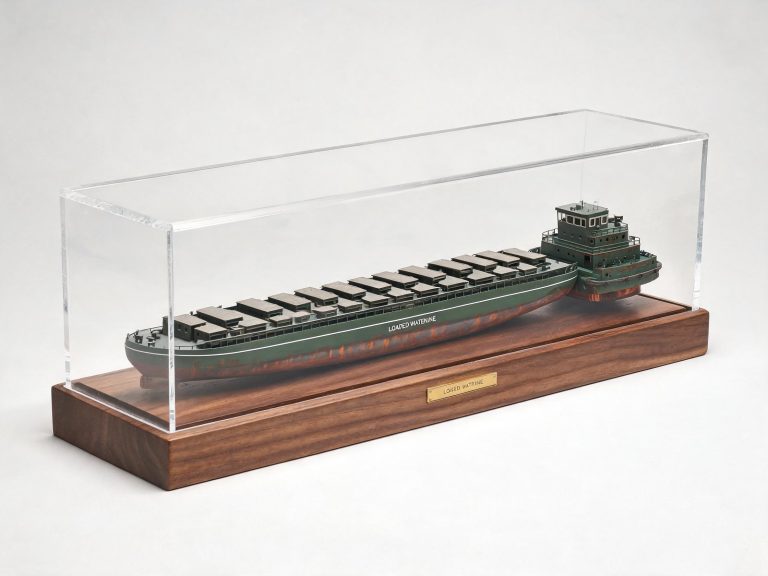
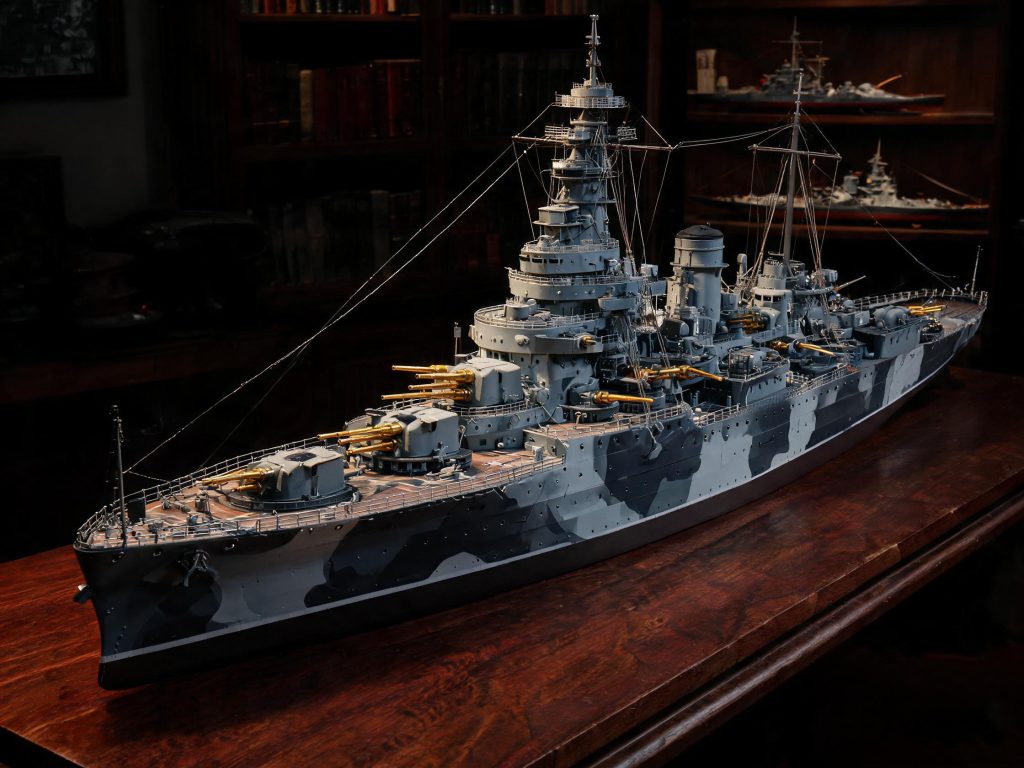
A warship model is the most demanding commission in the trade. Hull lines are complex. Armament is dense. The paint scheme carries history.
It is also the most rewarding — when it is done right.
What Makes a Warship Commission Different
A warship is a weapons platform, not just a hull. A credible model has to resolve three layers at once:
- The hull. Bulbous bows, torpedo bulges and skegs vary by class and era.
- The armament. Turrets rotate, barrels elevate, mounts sit at the correct height.
- The sensor masts. Radar arrays, direction finders and antennas define the silhouette.
Miss any layer and the model reads as a toy. Get all three and it reads as the ship.
Warship Types We Build
Each type has its own modelling logic.
Destroyers and Frigates
Long, lean and crowded. Deck space is scarce, so every winch, launcher and boat counts.
At 1:150 a destroyer reaches 70–110 cm. Railings sit under a millimetre from the deck edge.
Cruisers
Cruisers reward the middle ground. Superstructure blocks stack in clear tiers.
Battery turrets and secondary mounts give the deck its rhythm. A 1:150 cruiser typically lands at 1.2–1.4 m.
Battleships
The flagship commission. Main turrets alone carry 9–12 barrels each at correct calibre.
Armour belt, torpedo bulges and catapult decks must follow the refit state you choose. Battleships of 1.5–2.5 m are museum-class builds.
Aircraft Carriers
Carriers are flight decks first. Deck markings, arrestor wires and elevator cuts set the accuracy bar.
An air group can be included — folded wings, deck tractors, crash barriers — or the deck can run empty for a cleaner look.
Auxiliaries and Era Limits
We also build supply ships, tugs and landing craft. Anything from the ironclad era onward is workable.
Pre-dreadnought subjects are quoted after a reference review — the older the vessel, the more the reconstruction depends on period plans.
Choosing the Scale
Scale decides everything: the footprint, the detail depth and the price band.
- 1:96 – 1:150. The collector range. Turrets and rangefinders keep real detail. Destroyers reach 70–110 cm; battleships 1.5–2.5 m.
- 1:200 – 1:350. For full fleets. Several eras on one shelf, or a single carrier that still fits a room.
- Under 1:350. Presentation scale for offices and gifts — silhouette accurate, armament simplified.
Our rule of thumb: pick the scale that fits the space, then let detail follow. Send us the display dimensions and the class you have in mind — we confirm the best ratio with the quotation.
Paint Schemes and Markings
This is where warship models live or die.
- Grey schemes. Never one flat grey. Measure-shaded hulls, darker boot-topping, correct pennant numbers.
- Dazzle and camouflage. WWI and WWII patterns are plotted panel by panel. A typical dazzle scheme carries 20–40 geometric fields, each positioned from reference drawings.
- Weathering — by choice. Clean mint condition or operational wear. Decide before the first primer coat.
Camouflage drawings and pennant histories are confirmed with you during the 3D approval stage. The scheme, the year and the pennant are locked in writing before paint.
Materials and Detailing
Hulls are CNC-lofted and hand-faired. Superstructures follow the same controlled path.
Detailing combines three material families:
- Brass fittings. Barrels, masts and fine rods that keep their line for years.
- Photo-etched parts. Railings, ladders, radar lattice and gratings at true scale thickness.
- Resin castings. Boats, mounts and sensors reproduced in small series.
Rigging on masts uses stretched line at correct scale diameter. At 1:150, that means line under a millimetre.
See the standard in a finished commission: our battleship scale model case. For historical accuracy standards, our 1:1 precision ship model guide explains how references are graded.
From Drawings or Photos
Naval drawings give the shortest path. General arrangements, hull lines and rigging plans translate directly into the build.
No drawings? Period photographs plus dimensions work too. We loft the hull from the photos and mark every reconstructed detail in the approval file.
How to Commission Yours
The full process is in our ship model ordering guide. For warships it adds one step: scheme confirmation — camouflage pattern, pennant number and year profile are locked in writing before paint.
- Send the reference. Drawings, photos, or just the class name and target year.
- Fixed quote in one working day. Scale, price, production time.
- 3D hull and scheme approval. Production starts only after your written sign-off.
- Weekly progress photos. Rigging, turrets and paint reviewed stage by stage.
- Insured door-to-door delivery. Custom crate, foam bedding, numbered setup instructions and remote video guidance — backed by a 1-year warranty.
Builds of 1 m+ typically run 60–120 days. Larger battleship commissions run longer; the schedule is fixed before production starts.
FAQ
Can you build from period photographs only? — Yes. Archival photos plus the vessel’s dimensions are enough. We loft the hull and submit a 3D render for your approval.
What does a 1:150 destroyer cost? — Collector-class destroyers around 1 m start near USD 8,000; battleships of 1.5 m+ start from USD 30,000. Display-class warships from 60 cm start around USD 200.
Can you match a specific year’s configuration? — Yes. Refit states differ — radar fits, armament changes, funnel caps. The target year is confirmed before lofting starts.
Do you build as museum exhibits? — Yes. Museum-grade warships ship with construction archives, numbered certificates and UV-protective display cases — see our museum grade ship model service.
Ready to commission a warship model? Send the vessel reference — drawings, photos or just the name and year — and we reply with a fixed quotation within one working day.