
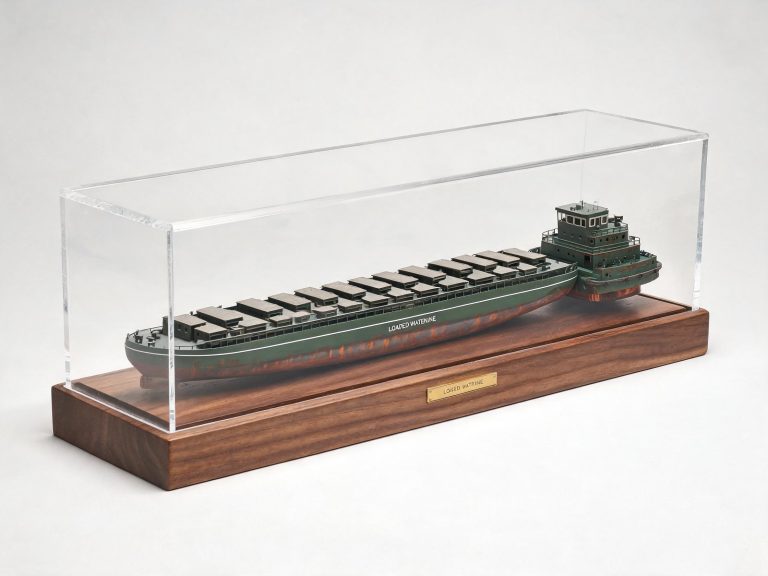
Scale is the first decision on any ship model, and it is usually made backwards. People pick a ratio they have heard of, then discover the model does not fit the shelf.
Work from the finished length instead. The ratio follows.
How Ship Model Scales Work
Divide the real length by the scale. A 140 m ship at 1:200 is 700 mm. The same ship at 1:100 is 1,400 mm, and at 1:1200 it is 117 mm.
140 m vessel at 1:100 1,400 mm
1:150 933 mm
1:200 700 mm
1:250 560 mm
1:500 280 mm
1:1200 117 mm
What Each Scale Can Hold
1:1200 Silhouette only. Railings vanish, deck gear becomes texture. Use it for fleets on one wall, never as a single display piece.
1:500 Deck houses read at 2 mm. You get the hull shape, the funnel and the superstructure blocks. No railings, no ladders.
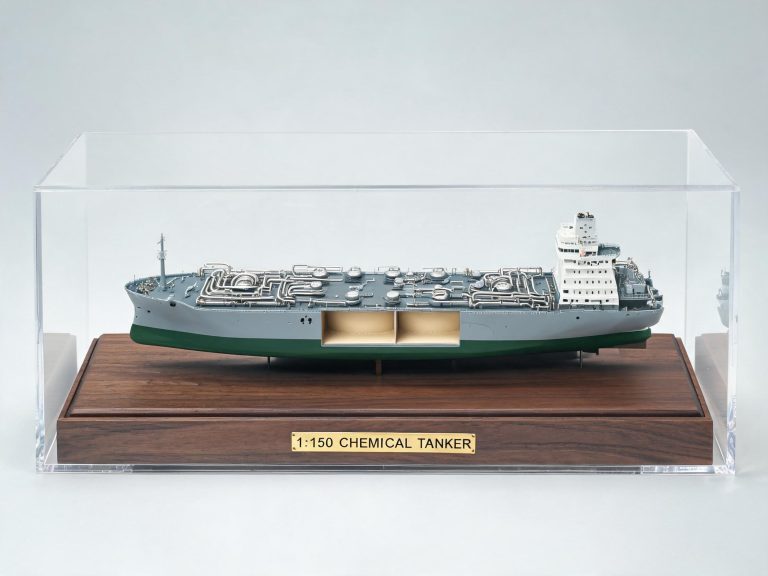
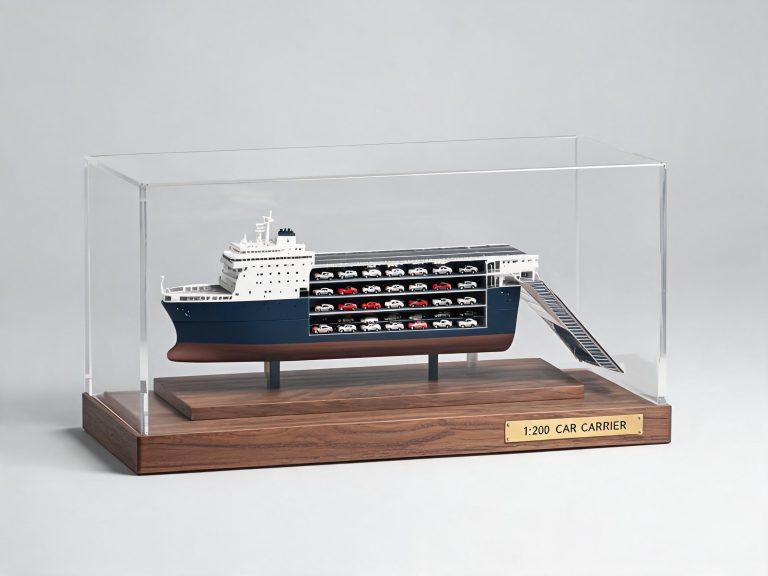
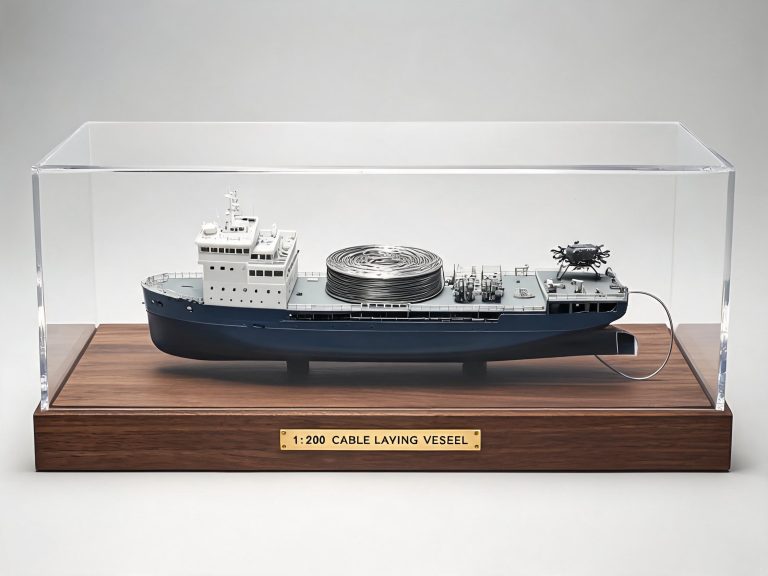
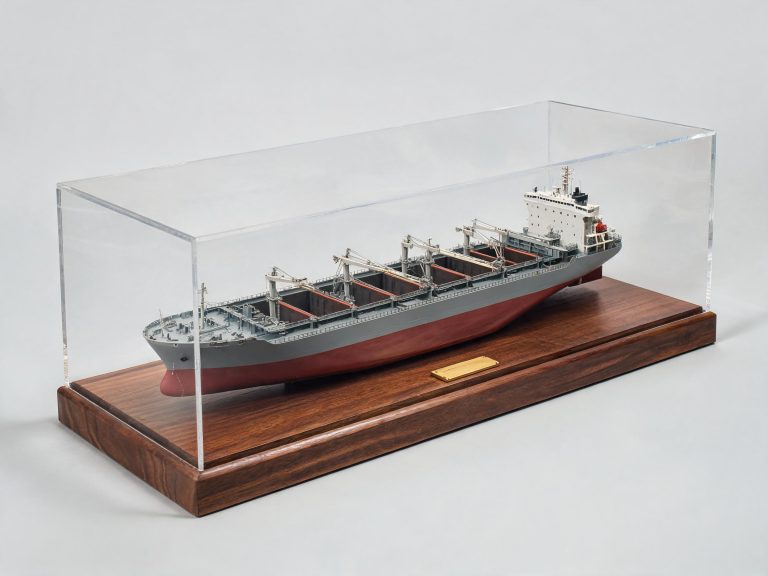
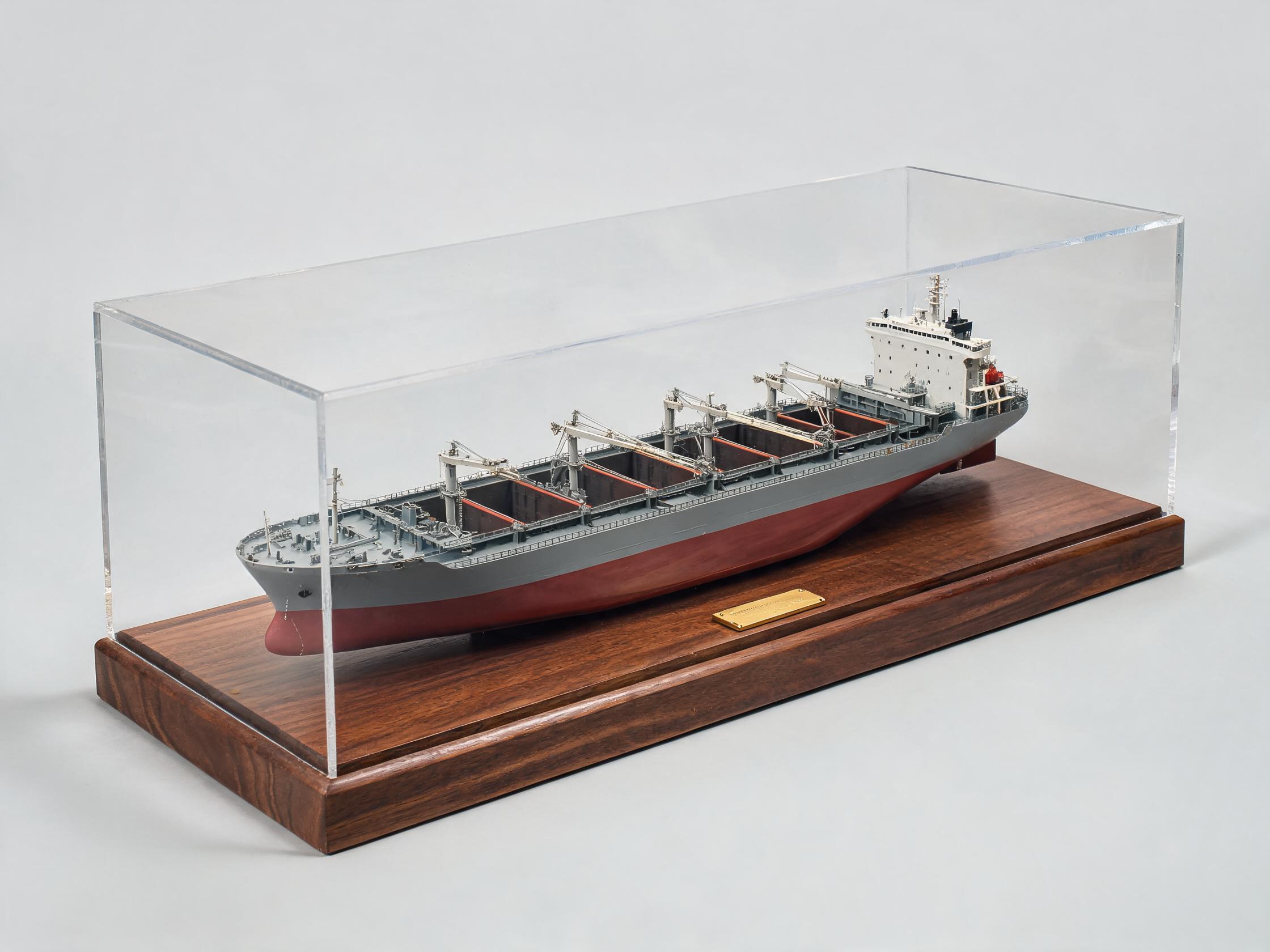
1:200 The working compromise. Railings at 0.5 mm, cranes, winches, hatch covers, visible piping. This is the scale we use for most commercial hulls.
1:150 Adds readable deck plating, stairways and lifeboat davits. A 140 m ship becomes 933 mm.
1:96 Museum territory. Full rigging on sailing ships, individual stanchions, open bridge windows. A 60 m frigate becomes 625 mm, a 55 m tall ship 573 mm.
1:48 The largest we build regularly. A 55 m tall ship becomes 1,146 mm with 18-24 sails and 900 rigging lines. Below 1:48 the model stops being a model and becomes furniture.
Which Scale Fits Your Room?
The rule we use: the viewer should stand at 1.5 to 2 times the model length away. A 700 mm model needs 1.1-1.4 m of clear floor or wall. A 1,500 mm model needs 2.3-3 m, plus 150 mm behind it for the case door.
Shelf depth matters more than length. A 700 mm model at 1:200 sits on a 250 mm deep shelf. At 1:96 the same ship is 1,458 mm long and needs a 400 mm shelf, or a plinth, or a floor.
Why 1:96 and 1:200 Are Our Two Defaults
1:96 is 1/8 inch to the foot, the old shipyard drafting scale, and most surviving general arrangement drawings are still dimensioned that way. 1:200 is the commercial shipping standard, and it keeps a 300 m hull inside 1,500 mm.
Between them they cover almost every brief. Anything outside those two comes from a display constraint, not from a preference.
Do You Have to Keep One Scale Across a Fleet?
For a comparison wall, yes. Six ships at 1:200 let a viewer read size differences directly, which is the whole point. Mixing 1:200 and 1:500 on one wall destroys that reading.
For separate rooms, no. The wooden tall ship model at 1:96 and a bulk carrier ship model at 1:200 can live in the same building without conflict, because nobody sees them side by side.

Scale and Freight
Doubling the scale multiplies crate volume by eight. A 700 mm model ships in a 900 x 300 x 400 mm crate at 18-24 kg. A 1,458 mm model needs 1,750 x 500 x 600 mm at 55-75 kg, and air freight is charged on volume weight, not actual weight.
If the model is going overseas and the budget is tight, 1:200 is not a compromise. It is the scale that survives shipping without a specialist art handler.
Five Scale Mistakes We See Every Month
1. Choosing the scale before measuring the space. A 1,400 mm model on a 1,200 mm shelf is a rebuild, not a display.
2. Forgetting the case. The case adds 60-80 mm on every side. A 700 mm model becomes a 860 mm footprint.
3. Mixing scales on one wall. Size comparison stops working the moment two ratios share a wall.
4. Scaling from a photo. A photo has perspective distortion of 3-8% at the bow. Use the drawing, or accept the error.
5. Assuming 1:100 is twice 1:200. It is four times the surface and roughly four times the fittings, so budget 3.5-4.5 times the price, not double.

Scale, Detail and the 0.4 mm Rule
Our bench rule: if a feature is thinner than 0.4 mm at the chosen scale, it will not survive handling or shipping. At 1:200 that means anything under 80 mm on the real ship disappears. At 1:96 the limit is 38 mm.
This is why 1:500 models look right from two metres and wrong from thirty centimetres. They are not badly made. They are below the detail threshold of their own scale.
Frequently Asked Questions
What is the most common ship model scale?
1:200 for commercial ships and 1:96 for museum and sailing ships. Those two cover about 80% of the models we build.
Can you build at a scale that is not a round number?
Yes. We build to fit a display, so 1:187 or 1:143 are normal. The ratio is whatever makes the model 1,200 mm in the space you have.
Does a smaller scale cost less?
Usually, because part count drops. But a 1:500 model with 40 parts is not cheaper per part. Our custom ship model service quotes by part count and hours, not by size.
How do I check a scale before ordering?
Cut a cardboard rectangle to the finished length and width and tape it where the model will sit. Two minutes of cardboard saves a rebuild. The museum grade ship model page lists the dimensions at each standard scale.
If you already know the ship and the shelf, send both numbers and we will return three scale options with finished lengths and prices. The container ship case study shows how a 1:200 hull was sized against a 2,400 mm wall, and the contact page takes the drawing.