
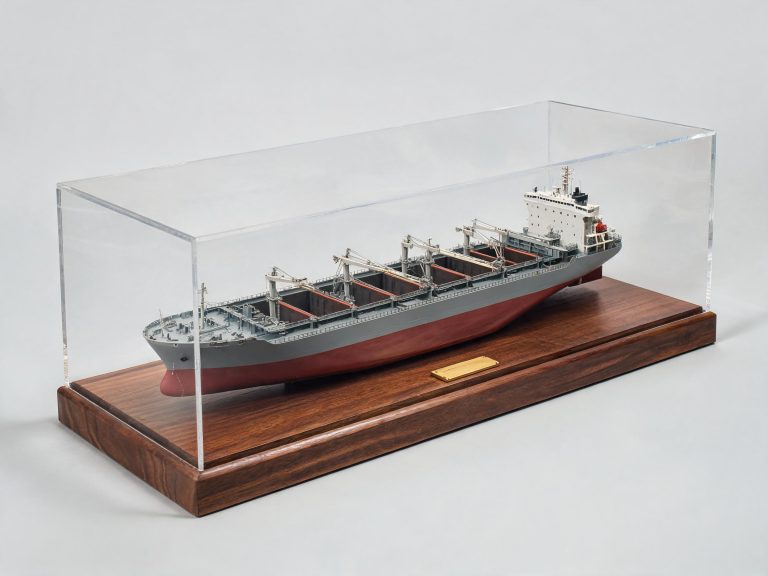
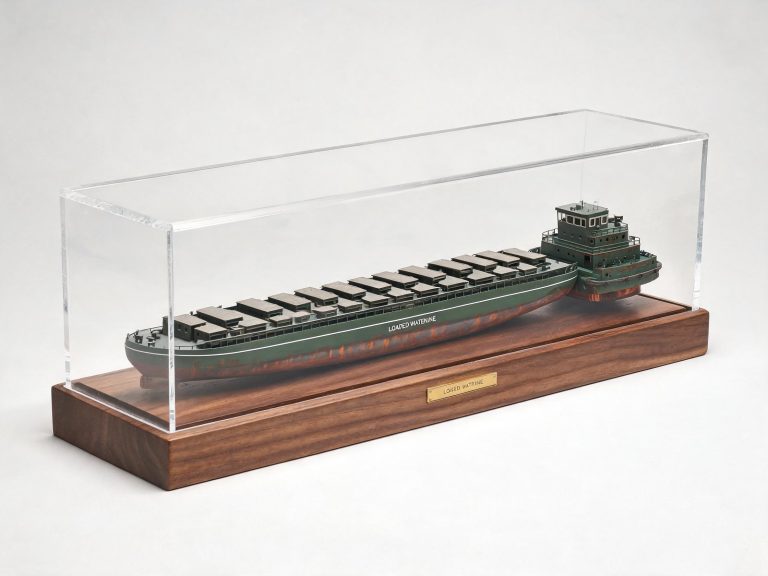
This capesize bulk carrier model started as a roll of drawings, not a crate. Nine weeks later it left the workshop in a plywood box.
We filmed the whole build. Below is what happens between the yard’s lines plan and the moment the lid goes on.
A 290 m capesize at 1:200 measures 1450 mm over the hull. That is the number that decides everything else: the case, the table it sits on, the way it is packed.
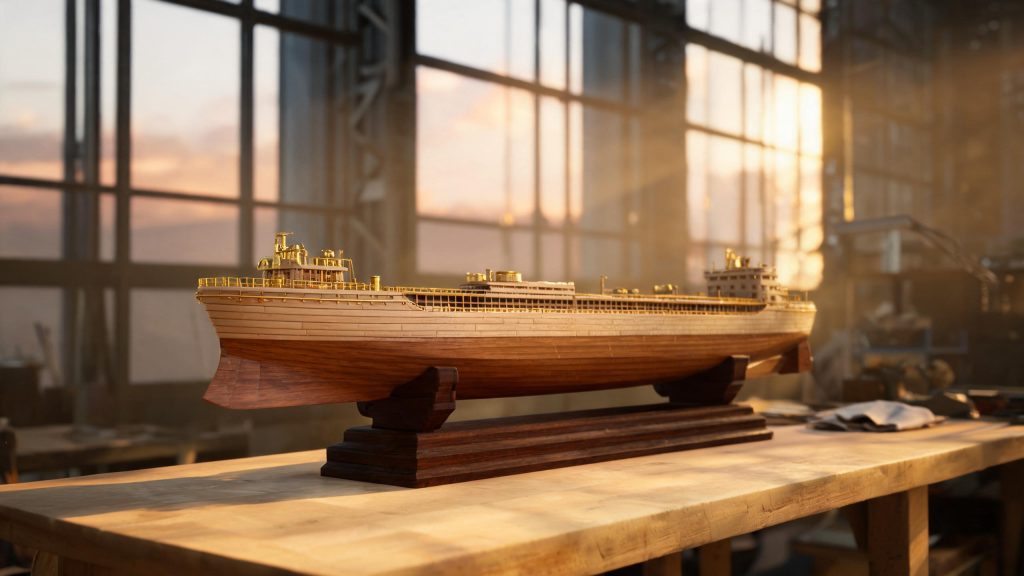
Why 1:200 for a Capesize Bulk Carrier Model
Clients rarely ask for a scale. They ask for a length that fits a room.
At 1:200 the hull is 1450 mm and the case lands at about 1600 mm. That clears a 2.4 m boardroom table without eating the whole surface.
At 1:150 the same ship becomes 1930 mm, and the case passes 2.1 m. Fine for a museum, awkward for an office.
At 1:100 it is 2.9 m. We have built two at that size. Both went to exhibition halls, and both needed a crate the size of a small wardrobe.
So 1:200 is the working default. Not a rule, but close to one.
From the Lines Plan to the 3D Check
The yard sends twelve drawing sheets: lines plan, general arrangement, midship section, deck plan. Sometimes a photo set from the delivery ceremony, which is useful for colour and small details.
Reading the drawing
First job is turning paper into numbers. We pick twenty station lines and enter them as coordinates, then check the result against the printed body plan.
The area that causes the most work is the forebody. A capesize bow is full and blunt, and a small error there shows up as a flattened nose at model scale.
What the 3D check catches
Every build gets a 3D pass before any wood is cut. Three days of work that saves three weeks of rework.
Two things get caught most often. One is the accommodation block sitting too far aft by a few millimetres, which at 1:200 is half a metre of real ship. The other is hatch spacing drifting against the deck plan.
Both are invisible on screen until you measure. Both are obvious on a finished model.
The Hull
The hull starts as three pine blocks laminated together. Pine because it holds shape and sands clean. Basswood goes on top, where the finish has to be fine.
Carving is by hand, guided by templates cut at every fifth station. Then filler, then long sanding blocks until the shadow line under the bilge reads straight from six metres away.
That takes about three weeks for one hull at this size.
Planking the deck
Deck planking is basswood strip at 1.2 mm. Roughly six hundred pieces per deck, laid from the centre line outward so both sides mirror exactly.
The seams are what people notice. A model with wandering plank lines looks wrong even to someone who cannot say why.
Deck and Fittings
Most capesize bulkers are gearless. No cranes, no derricks. That surprises clients who are used to handysize ships.
Instead the deck carries nine hatch covers, the hatch coamings, ladders, air pipes, manifold stations and mooring fittings. On our 1:200 build that came to just over two hundred brass and photo-etched parts.
The hatch covers are the biggest single job. Nine of them, each with its own hydraulic arms, all sitting at the same height along a deck that curves gently toward the ends.
We check that line with a straight edge across all nine. If it wobbles, it goes back.
Paint
Colour comes from the yard’s paint code, never from a photograph. Photos lie: a hull red shot in Qingdao morning light reads warmer than the same red shot in dry dock.
We spray a small test panel first and send it for approval. Most clients approve in one round. If they do not, we mix again before the model is masked.
Three coats on the hull. Two on the deck. Varnish only where bare wood is meant to show.
The Case and the Crate
The case is acrylic with a lift-off cover, on a walnut base with a brass plaque. The plaque carries the hull number and the delivery year, nothing else.
Inside the crate the model sits in foam cut to its own hull lines, with a thermal blanket over the top. We have shipped across the North Atlantic in February and had nothing move.
Total build time: nine weeks. Hull three, deck and fittings three, paint one, case and crate two.
What a Build Like This Costs
At 1:200, a capesize with full deck detail and a cased base sits in the middle of our range. Price moves with four things: scale, deck detail, case type, and whether you want the hull full or waterline.
A fixed quote takes one working day once we have the drawing. No hourly billing, no change orders unless you change the brief.
Questions About Capesize Models
Can you build a specific hull number?
Yes. Send the lines plan and the GA and we build that ship, not a generic capesize. Hull numbers, funnel markings and the owner’s livery all go on the model.
How long does it take?
Nine weeks for 1:200 with full deck detail. Allow twelve if the model is over 2 m, or if you want working hatch covers.
Waterline or full hull?
Boardroom models are usually waterline. Full hull suits a museum, where visitors can walk around the propeller and rudder. Both cost the same at the same scale.
See the Finished Model
Our bulk carrier ship model page covers the range from handysize to capesize, and this delivery case shows where one of these ended up.
The custom ship model service explains scales, cases and what a drawing needs to contain.
Send a lines plan or a GA to the contact page for a fixed quote in one working day.