
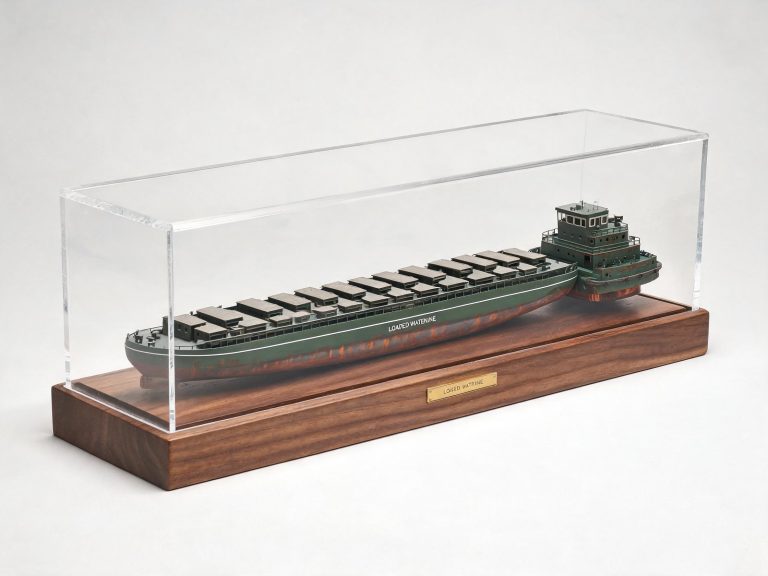
Many buyers think they need technical drawings to commission a ship model. They don’t.
A custom ship model from photos is our most common starting point. Collectors send holiday pictures of a grandfather’s trawler. Owners send phone photos of their own yacht. Museums send archive scans.
Photos plus one measurement — the vessel’s length — are enough to start.
Why Photos Are Enough
A ship’s hull follows strict proportions. From a clear side view, the hull shape can be lofted to any scale model size with high accuracy.
Superstructure details come from the remaining photos. Railings, vents, masts and deck gear are identified image by image.
Where a detail is unclear, we mark it and confirm with you — or reconstruct it from a sister vessel and record the assumption.
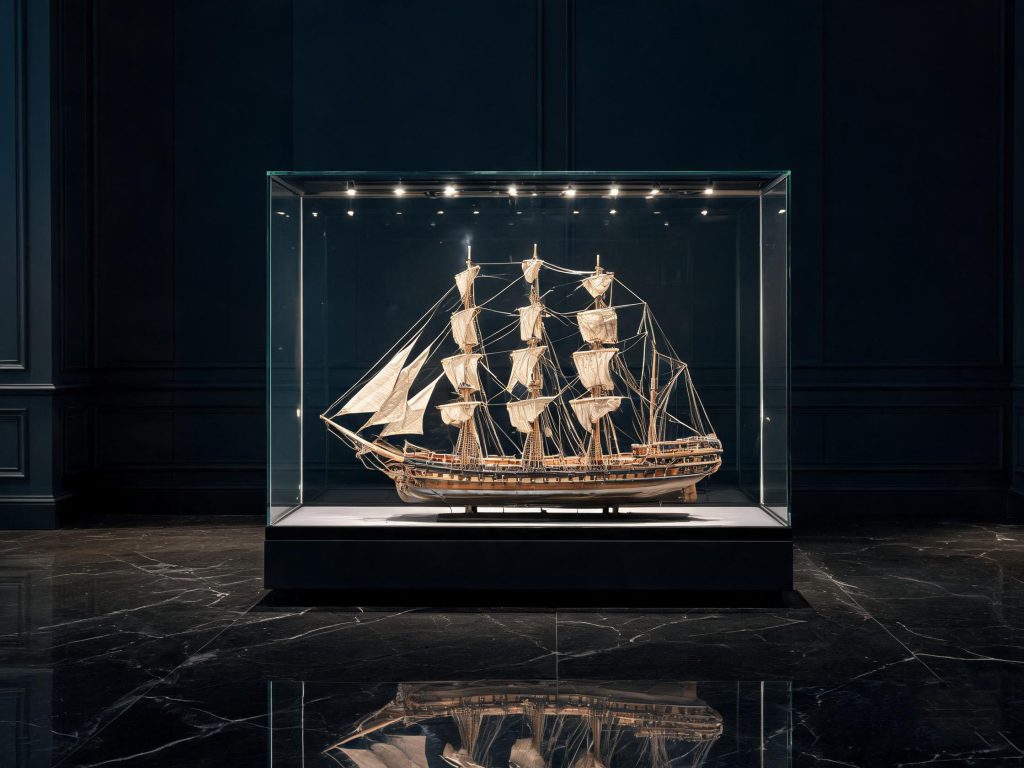
Which Photos to Send
The more of these you can provide, the tighter the accuracy:
- A straight side view. The single most useful photo. Square to the hull, full length in frame.
- Bow and stern views. They fix the profile at both ends.
- Deck shots. Forecastle, midship and aft — railings, winches, anchors, boats.
- Superstructure details. Bridge windows, funnel, masts, lifeboats, radar.
- Color references. Photos taken in daylight beat evening shots under warm light.
Don’t have all of these? Send what you have. We tell you honestly what can and cannot be reproduced before you pay anything.
How We Judge Photo Quality
Not every photo survives the lofting desk. Here is what we look for:
- Straight horizon. A tilted photo skews the sheer line. We correct small angles, but extreme perspective distorts the hull.
- Full length in frame. A bow cut off mid-frame cannot anchor the profile.
- Even light. Heavy shadows hide hull shading and porthole rows.
- Known reference point. A person, a door or a container beside the hull helps us lock the scale.
Archive photographs are assessed the same way. Film scans from 40 years ago have produced excellent models — the side view matters more than the megapixels.
From Photos to Hull Lines: The Technical Path
The translation from photos to a build runs in four steps:
- Scale lock. Your measurement fixes the ratio. Every following dimension derives from it.
- Lofting. The hull’s waterlines are drawn from the side view and cross-checked against bow and stern shots.
- Detail mapping. Each photo gets a position on the deck plan. Windows, doors and fittings are placed one by one.
- 3D verification. The full vessel is modelled in 3D and rendered for your review from every angle.
You approve at step 3 and again at step 4 — in writing, in plain language. Production starts only after that.
How Accuracy Is Controlled
The commission follows three checkpoints:
- Hull lines approval. We loft the hull from your photos and show you the lines drawing.
- 3D render approval. The full vessel in 3D, from all angles. You mark corrections in plain language.
- Progress photos. Weekly updates during the build. Problems are caught while they are still cheap to fix.
For buyers who want to go deeper into tolerance standards, our 1:1 precision ship model guide explains how accuracy is defined and measured.
What It Costs
Photo-based commissions use the same pricing as drawing-based ones:
- From 60 cm — from USD 200. Display class, fiberglass hull, painted livery.
- Over 1 m — from USD 8,000. Collector class with full rigging and lighting.
- Over 1.5 m — from USD 30,000+. Museum class with archive documentation.
A photo-based build of a 30 ft yacht at 1:50 is a typical first commission. See the result quality in our superyacht showroom case, and browse our sailing yacht model options for display-class examples.
Photo archives with heavy reconstruction belong in our museum grade ship model service, where every assumption is documented.
FAQ
How accurate is a model built from photos? — For hull shape and overall profile, extremely accurate. For small details hidden in the photos, we reconstruct from sister vessels — and tell you exactly where.
What if my photos are old or blurry? — Send them anyway. Partial references often work. We confirm feasibility before quoting.
How many photos are enough? — A straight side view plus five to ten detail shots covers most vessels. The length measurement matters as much as the photo count.
Can you add details I know but can’t photograph? — Yes. Describe them or sketch them. We translate your notes into the build plan.
Have photos ready? Send them for a quotation — you receive a fixed price and a feasibility answer within one working day.