



Introduction
A model railroad without vegetation is a barren landscape.
Track and trains alone tell only half the story.
Grass, trees, bushes, and ground cover are what turn a collection of plywood and plastic into a living, breathing miniature world.
Realistic model railroad scenery vegetation is the art of creating believable plant life at scale.
It transforms flat surfaces into meadows, forests, and field edges. It softens the hard lines of track ballast and blends structures into their surroundings. Done well, vegetation makes viewers forget they are looking at a model.
This guide covers everything from selecting the right materials to mastering advanced techniques like static grass application and hand‑crafted trees.
You will learn how to create depth, texture, and seasonal variation – and how to integrate vegetation seamlessly into any layout, whether you are working on a custom N scale model railroad layout or a sprawling HO empire.
Let us begin.
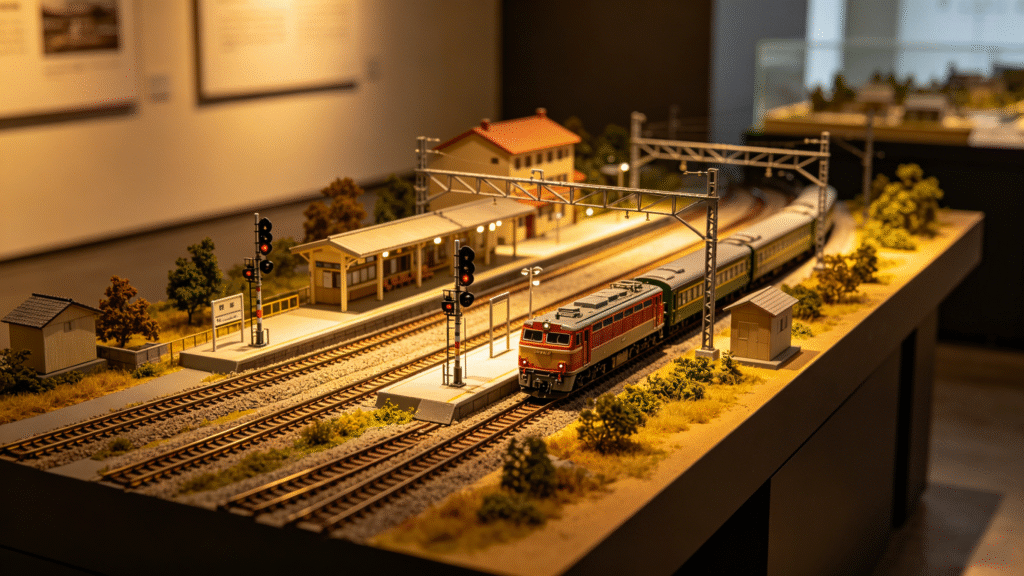
Section 1: The Foundation – Landforms and Base Colors
Before any grass or trees can be added, the land itself must be shaped and coloured.
Shaping the Terrain
Scenery starts with the basic landform. Two methods are most common today:
1. Carved foam (Styrofoam board) – Cut layers of pink or blue extruded foam into contour shapes, glue them together with panel adhesive or low‑temperature hot glue, then carve away the steps using a long‑bladed utility knife, a hot‑wire foam cutter, or even a drill‑mounted wire brush. Spraying the foam with water keeps dust down. Once carved, the surface can be coated with Sculptamold or lightweight joint compound to provide a smooth, paintable base. [13†L19-L34]
2. Plaster‑impregnated gauze – Drape strips of wet plaster gauze over a lattice of cardboard strips or crumpled newspaper. Overlap each piece by about 25 % until the form is covered. Once dry, it becomes a hard, lightweight shell ready for colouring. [13†L39-L47]
For those building a custom N scale model railroad layout, foam carving is often preferred – it produces less mess when done correctly and allows precise control over subtle terrain variations that read well in smaller scales.
Base Colour
Once the landform is dry, apply a base coat of earth‑toned acrylic paint. This provides a uniform foundation that masks any gaps and serves as a backdrop for ground cover. Browns and ochres work well for most landscapes, with darker shades in low areas and lighter tones on hilltops.
A custom model train track scenery approach integrates vegetation right up to the rail edge. Ballast is applied first (a 50:50 white glue and water mix applied with an eyedropper after wetting with detergent water), then ground cover is layered around it, with small grass tufts deliberately placed between the rails and along the ballast shoulder for a natural, weathered look. [14†L7-L9][7†L44-L46]
Section 2: Static Grass – The Gold Standard for Realistic Lawns and Meadows
Static grass has revolutionised model scenery. Unlike traditional flocking, which lies flat, static grass fibres are electrostatically charged so they stand upright – just like real grass blades. [7†L3-L7]
Tools and Materials
- Static grass applicator – Professional electronic models offer the best control. Puffer bottles or tea strainers work for shorter fibres (2mm or less) but produce less vertical alignment. [7†L8-L11]
- Grass fibres – Available in lengths from 2mm (manicured lawns) to 12mm (rough meadows). Shorter grasses tend to be greener and more vibrant; longer grasses are darker and more mature. [7†L51-L52]
- Adhesive – PVA (white) glue diluted 1:1 with water, or dedicated static grass glue applied with a brush.
Application Steps
- Prepare the base – Ensure the terrain is painted with an earth colour. Browns are better than greens for thinly covered areas. [7†L15-L20]
- Apply adhesive – Spread glue evenly over the area to be grassed. [7†L21-L22]
- Load and apply fibres – Loosen the fibres before filling the applicator (use a fork or coarse sieve). Hold the applicator close to the surface and release the fibres; the static charge makes them stand upright. [7†L23-L28]
- Build layers – For the most realistic results, apply multiple layers of different fibre lengths and colours. Start with longer, darker fibres for the base, then add shorter, lighter ones for highlights. Unless you are modelling a formal lawn, avoid uniform grass. [7†L44-L49]
Tip: Apply grass patches deliberately. Real fields have variations in colour and density – use a mix of green, yellow‑green, and brown fibres to mimic meadow grass. For a custom model railroad industrial scene design, limit grass to areas away from loading docks and track spurs. Heavy industry typically has bare ground, oil stains, and sparse weeds rather than lush lawns. [14†L20-L26]
Section 3: Trees – Adding Height and Character
Trees provide vertical interest, frame scenes, and anchor the landscape.
Fortunately, you do not need to buy expensive pre‑made trees – there are economical ways to build hundreds yourself.
Bottle‑Brush Conifers (Pine Trees)
A classic technique uses hemp rope, bailing wire, and green spray paint. Cut wire into 6‑8″ lengths, bend them in half, and insert them into a vice. Twist the wires together while feeding in strands of hemp rope. The result is a branched armature that resembles a pine tree. One modeller made 120 trees in under two days using this method. [9†L42-L44]
To improve realism, spray the armatures with a textured paint, then coat with hairspray and sprinkle on finely ground green foam. Use coarse foam first to give branches body, then fine foam for the needle texture. [9†L13-L15]
Deciduous Trees
For leafy trees, dried sagebrush (sold as “Super Trees”) provides naturally branching armatures. Soak the branches in matte medium to condition them (prevents long‑term degradation), then sprinkle on foam foliage or Noch leaf material. One package of Super Trees yielded over 100 trees for an N‑scale modeler, with a mix of summer and autumn shades. [10†L3-L7]
For a custom N scale model railroad layout, where a single tree may be only 25‑50mm tall, the scale demands finer foliage. Use fine ground foam rather than coarse clumps, and place trees in distinct groups – foreground, midground, and background – to create depth without overcrowding the limited space. [3†L26-L28]
Low‑Cost Forest Canopy (Fiber‑Fill Method)
For large forested areas where individual trees are not practical, use an economical alternative: cut foam profiles in the shape of a treeline, glue them to the base, then cover the top with fiber‑fill (pillow stuffing) sprayed with hairspray and sprinkled with fine ground foam. This creates a continuous canopy that reads as a distant forest. One modeller used this technique to forest 60 linear feet of his N‑scale Appalachian layout at a fraction of the cost of individual trees. [11†L4-L15]
Tree Placement
- Foreground trees – Highly detailed, individually placed. Use fine foliage and visible trunks.
- Midground trees – Less detailed, often clustered.
- Background trees – Simplified shapes; the fiber‑fill canopy method works well here.
When adding trees to a miniature model railroad village construction, place them behind buildings to provide a backdrop, along roads to frame the scene, and in small groves near the station to suggest a landscaped park. Avoid blocking sightlines to the trains. [5†L10-L13]
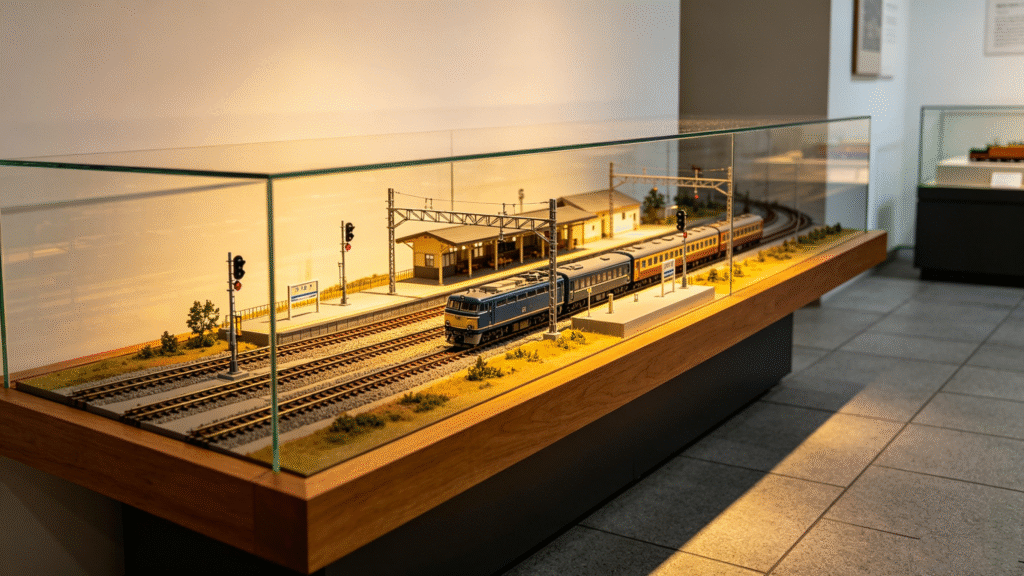
Section 4: Shrubs, Bushes, and Ground Cover Details
Vegetation is not just grass and trees. Low‑level plants add texture and fill gaps between ground cover and tree trunks.
Shrubs and Bushes
Pre‑made shrub clusters are available from Noch, Woodland Scenics, and Gaugemaster. Alternatively, make your own using clumps of ground foam glued to small bases, or use preserved lichen.
Weeds and Tall Grass
Static grass in 6‑12mm lengths, applied in small tufts, works well for weeds along fence lines and track edges. Mix in a small amount of tan or straw‑coloured fibres to suggest dead vegetation.
Bare Ground and Dirt
Not every surface should be green. On an industrial layout or in a busy yard, bare earth is common. Use fine sifted dirt, real sand, or ground‑up real rock (Arizona Rock and Mineral is a favourite among serious modellers) mixed with diluted white glue. [6†L49-L51]
Roadside Verges
The edges of roads and tracks are prime locations for vegetation. Use a narrow strip of static grass, gradually thinning toward the road centre. A weed or two growing through the asphalt adds realism.
On any custom model train track scenery, pay special attention to the transition between ballast and the surrounding ground – a gradual blend of textures, rather than a hard line, creates the most believable effect. [6†L17-L21]
Section 5: Colours, Textures, and Seasonal Effects
Real landscapes are never a single shade of green. The most effective scenery uses a palette of multiple colours and textures.
Grass Colour Variation
- Bright green – Fresh spring growth, irrigated lawns.
- Olive green – Summer pastures.
- Yellow‑green – Dry or overgrazed fields.
- Tan/straw – Late summer or drought conditions.
Apply static grass in patches rather than solid blocks. Let the brown base colour show through in places.
Forest Floor
Under trees, the ground is often bare or covered with leaf litter. Use fine brown turf, crushed walnut shells, or ground foam in autumn colours – then add a few fallen leaves made from punched paper.
Hedgerows
In the UK and parts of North America, hedgerows define field boundaries. Build them by layering static grass and coarse foliage along a strip of card, then placing them between fields.
Autumn Scenes
Model autumn by replacing some green foliage with orange, yellow, and red leaf material. Sprinkle a few individual “fallen” leaves on the ground. Autumn is a wonderful opportunity to add drama to any custom model railroad industrial scene design – a factory siding surrounded by turning maples can be stunning.
Winter Scenery
Even in winter, vegetation does not disappear entirely. Use bare tree armatures (wire branches with no foliage), static grass in pale tan colours, and ground foam in grey‑brown tones to suggest dormant vegetation. A light dusting of white (using ground foam or powdered gypsum) adds snow.
Section 6: Integrating Vegetation into Specific Layout Types
For a Custom N Scale Model Railroad Layout
N scale presents unique challenges: individual trees are tiny, and fine ground foam can look too coarse. Use extra‑fine foliage materials, and place trees in distinct foreground‑midground‑background layers to create depth. One modeller needed over 100 trees for a single corner of his N‑scale layout; he used the Scenic Express Super Trees method, which proved economical and produced convincing results. [10†L3-L7] [3†L26-L28]
The fibre‑fill forest canopy method is especially useful in N scale, where large forested areas can be created quickly without planting hundreds of individual trees. [11†L4-L15]
For a Custom Model Railroad Industrial Scene Design
In industrial areas, vegetation should be sparse and hardy. Use rough grass, weeds, and patches of bare earth. A few trees near the back of the property are credible; overgrown trackside weeds are essential. Avoid neatly manicured lawns unless the industry has a company‑maintained entrance. [14†L20-L26]
For a Miniature Model Railroad Village Construction
Village scenes benefit from planned landscaping: hedgerows, cottage gardens, park trees, and a village green. Use a variety of tree species – a large oak in the centre of the green, poplars along the road, and fruit trees in orchards. Include flower beds (tiny coloured static grass or punched paper flowers) for a lived‑in look. [5†L10-L15]
For a Custom Model Train Track Scenery Framework
Whenever you integrate vegetation, always apply ballast first (especially if using Unitrack, as its molded plastic ballast has ruler‑straight edges that need softening with real ballast). Then weather the track and ballast with an airbrush or powders before adding grass. This ensures the vegetation sits on top of the ballast, not underneath it, and creates a cohesive look. [15†L20-L33]
Section 7: Essential Products and Where to Find Them
Several manufacturers specialise in model scenery materials:
- Woodland Scenics – The most widely available brand. Offers static grass, ground foam, trees, and scenery supplies for all scales.
- Noch – German company known for high‑quality static grass, grass mats, and pre‑made trees. Many modellers prefer Noch static grass for its realistic colours. [2†L29-L32]
- Scenic Express – Supplier of Super Trees and a wide range of fine foliage materials; highly recommended for serious scenery work. [10†L41-L43]
- Heki – Offers foam granules, tree kits, and natural‑colour lichen for ground cover. [1†L37-L41]
- Arizona Rock and Mineral – Premier source for realistic ballast, made from actual crushed rock. [6†L49-L51]
For those building a custom N scale model railroad layout, seek out extra‑fine ground foam and fine static grass fibres (2‑4mm) to maintain proper scale. Heki’s fine turf and Noch’s fine leaf material are excellent choices.
Section 8: Long‑Term Maintenance of Scenery Vegetation
Vegetation is delicate and can degrade over time. To keep your layout looking fresh:
- Dust regularly – Use a soft brush or compressed air. Dusting removes particles before they settle permanently.
- Reapply glue – Over the years, static grass may loosen. A light spray of matte medium or thinned white glue can re‑secure loose fibres.
- Touch up faded areas – Sunlight and fluorescent lights can fade colours. Keep small bottles of your original ground foam mixes for touch‑ups.
- Store the layout under a dust cover when not in use, and for the most vulnerable modules, consider a Custom Protective Case For Sand Table Model to shield delicate vegetation from dust and accidental contact during storage.
Conclusion
Realistic model railroad scenery vegetation is one of the most rewarding aspects of the hobby. It transforms track and buildings into a believable world.
Start with a solid landform, apply a natural base colour, then layer static grass, shrubs, and trees. Use multiple shades and textures – nature is never uniform. Scale your materials appropriately, and do not be afraid to experiment.
Whether you are working on a custom N scale model railroad layout with limited space, designing a custom model railroad industrial scene design where vegetation tells a story of use and neglect, bringing a miniature model railroad village construction to life with gardens and hedgerows, or integrating vegetation into your custom model train track scenery to soften every rail edge, the techniques remain the same: layer, vary, and observe the real world.
Happy modelling.


Leave a Reply