
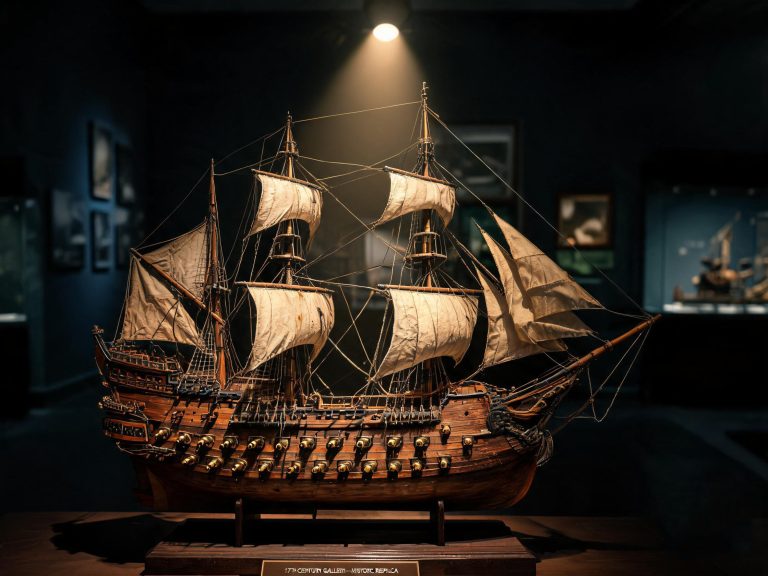
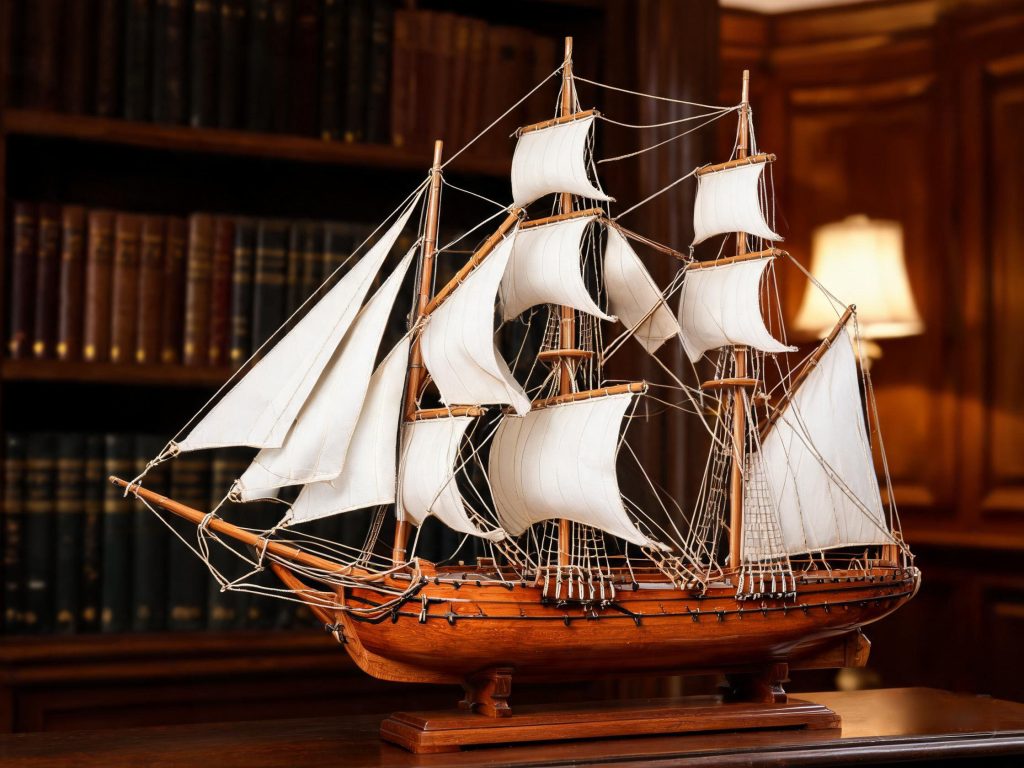
Tall ships, clippers and historic vessel replicas built from archival drawings, with hand-stitched sails and hand-tied rigging. Quote on request.
A wooden tall ship model is the most demanding work our workshop takes on, and the work we are proudest of. We reconstruct vessels from archival plans, period paintings and photographs, and consult maritime historians where the records are incomplete.
Which Ships Do We Reconstruct?
Four families of vessel come through the workshop most often.
Age of Sail frigates. 28 to 44 guns, built from Admiralty draughts where they survive. Gun count, port spacing and deck furniture all follow the original.
Clippers and tea traders. Composite and wooden hulls, 1850s to 1880s. These live or die on the sheer line and the sail plan.
Barques and brigantines. Working cargo sail, often the ship a client’s family or company has a link to.
Early steamships. Sail plus paddle or early screw, 1830s to 1860s. The hardest to research, because few drawings survived.
Research Before Building
Every replica starts with a research dossier: hull lines, rigging plan, sail plan, paint scheme and fittings, documented from primary sources.
The dossier runs 30 to 60 pages and takes 2 to 4 weeks. You review it before production, so the model is a documented reconstruction rather than a generic old sailing ship.
Where a plan is missing, we reconstruct from sister vessels and period photographs, and list every assumption in the dossier. Nothing is invented quietly.
Hand Skills in Every Wooden Tall Ship Model
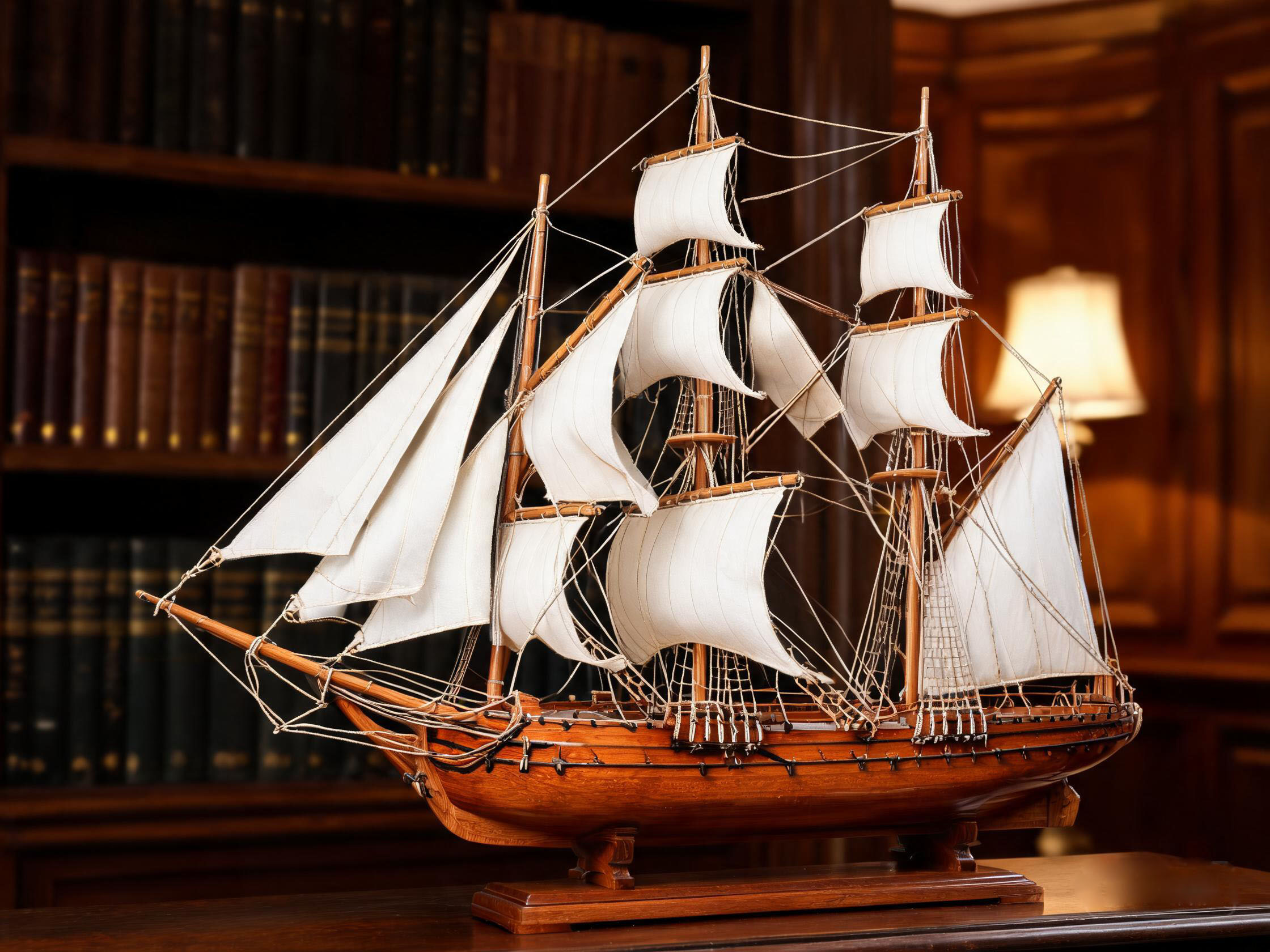
Sails. Hand-stitched from real cloth with visible seam lines. A three-masted full-rigger at 1:75 carries 18 to 24 separate sails.
Rigging. Standing and running rigging tied knot by knot to the original plan. A 1:75 full-rigger carries about 900 lines and roughly 1.2 km of thread, which is 180 to 250 hours of work on its own.
Hull. Plank-on-frame construction, basswood planking 1.5 mm thick, so the grain shows through the varnish as it does on the original. Frames are cut and set before a single plank goes on.
Fittings. Brass blocks, deadeyes, capstans and gun barrels. A 32-gun frigate needs 32 barrels turned individually.
Which Scale Should You Choose?
Scale is set by the wall or table the model will live on. The ship is fixed; the scale is not.
A 55 m frigate measures 573 mm at 1:96, 733 mm at 1:75 and 1146 mm at 1:48. Most private commissions land at 1:75, which keeps the rig readable without needing a case over 900 mm wide.
Below 1:200 the rigging stops reading as rope and starts reading as wire. Above 1:48 the case becomes furniture. We build between 1:48 and 1:200.
Watch the Build
Nine steps, from the lines plan to the crate. Two minutes.
Specifications
Scale 1:48 to 1:200
Overall length 500 mm to 2000 mm
Hull plank-on-frame, 1.5 mm basswood planking
Sails 18 to 24, hand-stitched cloth
Rigging up to 900 lines, about 1.2 km of thread
Rigging hours 180 to 250 per model
Fittings brass blocks, deadeyes, capstans, gun barrels
Research dossier 30 to 60 pages
Lead time 16 to 24 weeks
Price quoted per commission
Case acrylic or glass, UV-protective
Shipping 12 mm plywood crate, 30 mm foam, insured
Frequently Asked Questions
How long does a wooden tall ship model take to build?
16 to 24 weeks for a 1:75 full-rigged ship. Rigging alone accounts for 180 to 250 hours, and it cannot be rushed without showing.
What does a wooden tall ship model cost?
Quoted per commission. A 1.2 m motor yacht was delivered at USD 9,000; a rigged tall ship sits above that, because rigging is hand work that cannot be shortened.
Are the sails real cloth?
Yes. Hand-stitched cotton or linen with visible seam lines, shaped to the original sail plan. Not printed or resin-cast.
Can you build a ship from photographs only?
Yes, but expect a longer research phase. Photographs rarely give hull lines, so we reconstruct from sister vessels and mark the assumptions in the dossier.
How is the model packed and shipped?
Bolted to a plywood base inside a foam-lined crate, in three layers. Air freight from Shenzhen, or door delivery with the case already fitted.
Does it include a display case?
Yes. Acrylic or glass with UV filtering, set on a wooden plinth. The case is built after the model is finished, so the fit is measured, not estimated.
Can you work from museum or archival plans?
That is the usual route. Admiralty draughts, register entries and builders’ models give the lines. Photographs fill in the deck detail.
Can I follow the build?
Yes. Photographs every week, and a video call at the hull, deck and rigging stages. Nothing is hidden behind a finished-photo portfolio.
How fine is the rigging at 1:96?
900 lines on a three-masted ship, the finest under a millimetre. Every line is tied off at a deadeye or a belaying pin, not glued into a block.
What if the model arrives damaged?
Send photographs within 48 hours. Small parts ship as spares. A broken mast or yard is replaced and re-rigged here, not patched locally.
Where They End Up
Maritime museums, heritage foundations, historic hotels and private collectors who want a faithful piece of seafaring history. A working example is our 1:75 tall ship model, and the 1:96 historic replica shows the research dossier in practice.
Ordering a Wooden Tall Ship Model
Send plans, photographs or a vessel name to our workshop. We reply within one working day with a research estimate, a scale proposal and a production schedule.
For larger display pieces see the museum grade ship model, and the custom ship model service explains scales, cases and what a drawing needs to contain.
Wondering what a model like this costs? See prices by model length, from 300 mm to 2,000 mm, with the cover and crate included.
Every model ships with a cover. Compare acrylic, glass and timber cases.