
Subsea cables are invisible until they fail. The vessel that lays them is the visible part of the system.
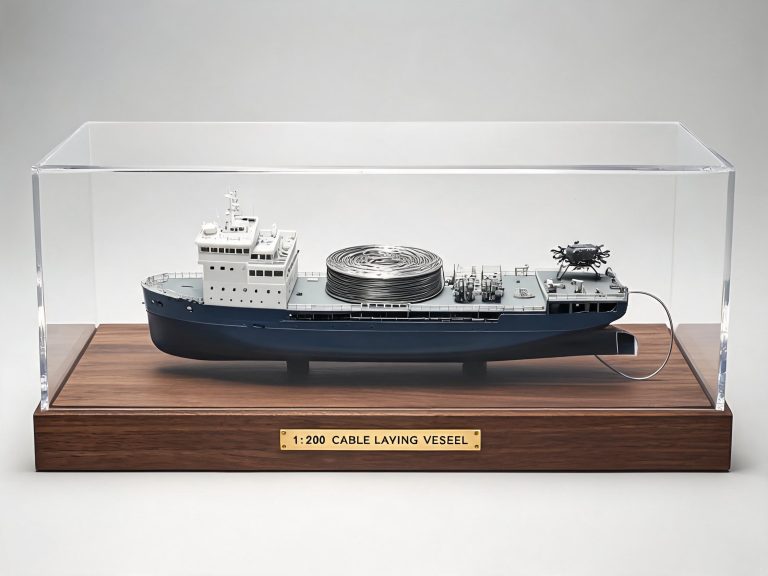
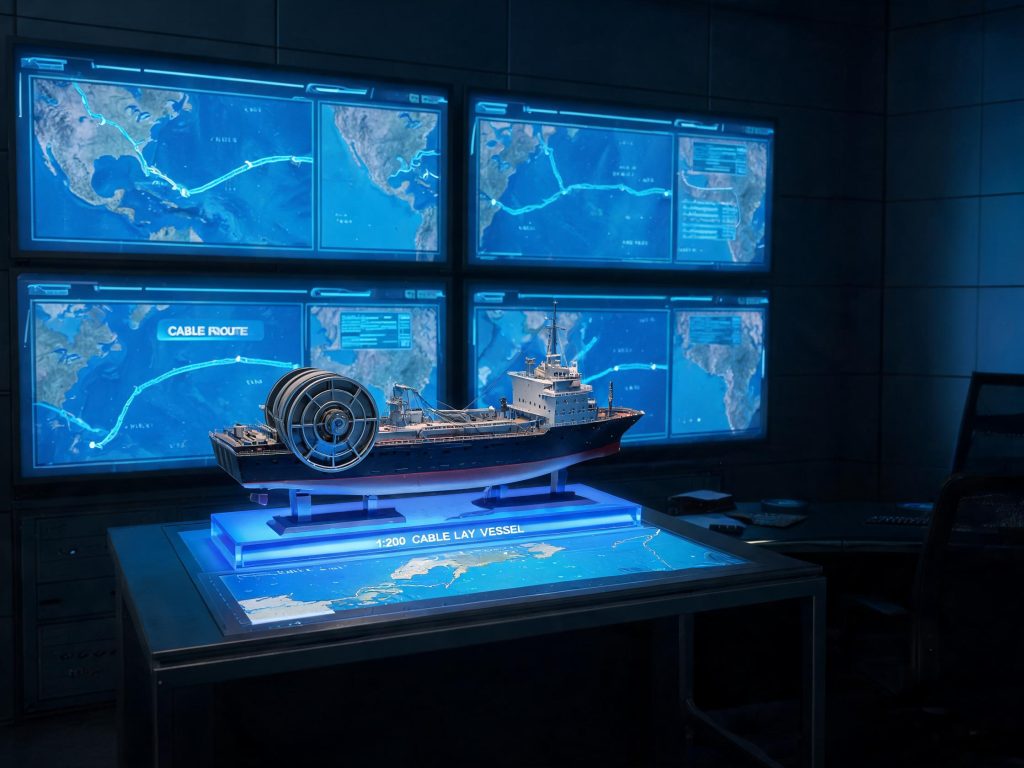
This cable lay vessel model was built at 1:200 for an operator’s network operations room. The ship is 140 m overall, so the model measures 700 mm from stern roller to bow and 160 mm across the beam.
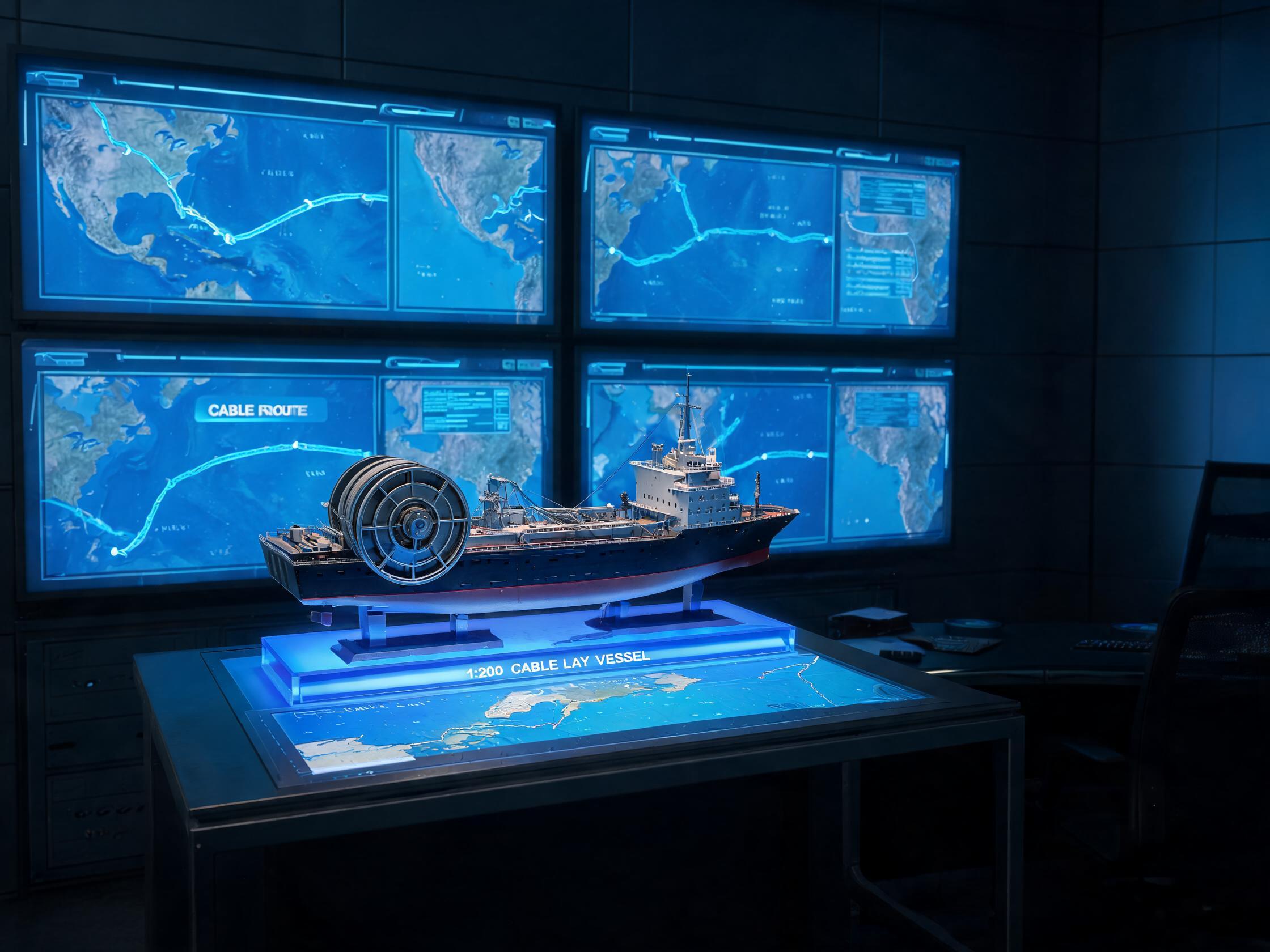
A Cable Lay Vessel Model with the Carousel Visible
The carousel is the identity of a cable ship. It sits amidships, it is huge, and it is the first thing anyone in the industry looks for.
Carousel and tensioners
We modelled the carousel with the cable spooling pattern, two tensioner pairs and two linear tensioners along the deck. The real drum is 16 m across, which gives 80 mm at 1:200 — enough to show the spool, the guide arm and 12 radial spokes.
The spooling pattern is printed from a photograph of the actual drum, so the wraps sit where the crew expects them, not in a neat decorative spiral.
Overboarding
The stern chute, the cable guide and three sheaves. Showing the cable leaving the ship is the single detail that turns a harbour vessel into a cable layer.
The cable runs from the carousel, over the tensioners, through the chute and 120 mm into the base, where it meets the printed route. It never stops mid-air.
ROV and survey fit
A working ROV on the aft deck, with the launch frame and the umbilical guide. A 3 m work-class ROV measures 15 mm at this scale, so the frame, the winch and the 4 mm umbilical do most of the reading.
Survey equipment is part of the ship’s job and belongs on the model, even when it is small enough to miss at two metres.
Built for an Operations Room
The room is dark most of the day, with wall screens showing cable routes. The model sits on a side console with a low backlight at 3000 K drawing 6 W, and it is used in briefings when a route changes.
We built the base with a printed cable route across the South China Sea, 4,200 km at chart scale, and small markers for three landing stations. The room’s engineers asked for that after the first review, and it is now the model’s main function.
What Fails First on a Cable Ship Model?
The carousel is the heaviest part of the model relative to its size. Without support the deck flexes by 1.5 mm when the case is lifted by the sides, so we added a hidden brass post under the deck at that point.
The cable itself is a photo-etched strip 0.8 mm wide, not thread. Thread frays, and a frayed cable on a cable ship model is the wrong joke. The strip holds a 3 mm bend radius without kinking and takes paint like brass.
Model Data
Scale 1:200
Overall length 700 mm
Beam 160 mm
Carousel 80 mm across, printed spooling pattern, 12 spokes
Deck gear 2 tensioner pairs, 2 linear tensioners, 3 sheaves, stern chute
ROV 15 mm work-class ROV with launch frame and umbilical
Parts about 1,850
Build hours 420
Backlight 3000 K, 6 W
Base 900 × 320 mm, printed route, 3 landing stations
Case 8 mm cast acrylic, UV blocking below 380 nm
Lead time 14 weeks
Price from USD 9,500
Questions About Cable Ship Models
Can the model show a specific cable route?
Yes. We print the route on the base from your coordinates, with landing points and shore crossings marked. Repeaters can be placed every 60 to 80 km if the route is long enough to carry them.
Can you model a cable repair vessel instead?
Yes. Repair vessels carry different deck gear, and we model the ROV, the grapnel arrangement and the stern working deck from your drawings. Allow 2 extra weeks for research if the drawings are incomplete.
Can the model be updated when the fleet changes?
The hull is fixed, but the deck modules and the base route can be replaced. We keep the files for five years, and a new carousel module takes 10 working days from approval.
How is a 700 mm model shipped?
In a 12 mm plywood crate with 30 mm foam, fully insured, 12 to 16 days door to door. The case travels in a separate box so the acrylic never carries the model’s weight.
Send the Deck Layout and Route
Send the general arrangement drawing, a photograph of the carousel and the route coordinates. A photograph of the drum is worth more than a written description of the spooling.
The custom ship model service explains what a drawing set needs to contain, and our 1:200 container ship model shows the same scale applied to a different working deck.
If the vessel is closer to a flat-top working hull, the barge model page covers deck equipment and load lines. For a display case built to museum grade display standard, the specification is on that page.
Send everything through the contact page for a fixed quote in one working day.