
What Is a Custom Model Train Carriage?
It is a passenger car made just for you.
A custom model train carriage matches your railroad’s style.
You decide the window layout, roof type, and lettering.
No two cars are ever the same.
The result is a stunning, one‑of‑a‑kind car.
Why Order a Custom Carriage?
Ready‑made cars look generic and common.
A custom model train carriage stands out in any train.
You control the paint, weathering, and interior.
Perfect for a signature passenger train.
Your carriage becomes a collector’s treasure.
How the Custom Order Service Works
First, share your ideas and reference photos.
Tell the builder your scale (HO, N, O).
Describe the era and railroad name.
They provide a design sketch and quote.
After approval, construction begins.
What You Receive
A handcrafted carriage with fine details.
A custom model train carriage includes interior seats and lighting.
Trucks, couplers, and window glazing are installed.
Weathering matches your layout’s era.
Ready to run on your tracks.
Pricing and Timeline
Basic carriages cost 150‑300.Mid‑levelcarswithinteriorscost150‑300.Mid‑levelcarswithinteriorscost300‑600.
Premium brass carriages cost $600‑1500.
Turnaround is 4‑10 weeks.
Shipping is carefully packed and insured.
Model Train Depot Miniature Custom Service
A depot for your carriage to stop at.
Use Model Train Depot Miniature Custom Service once.
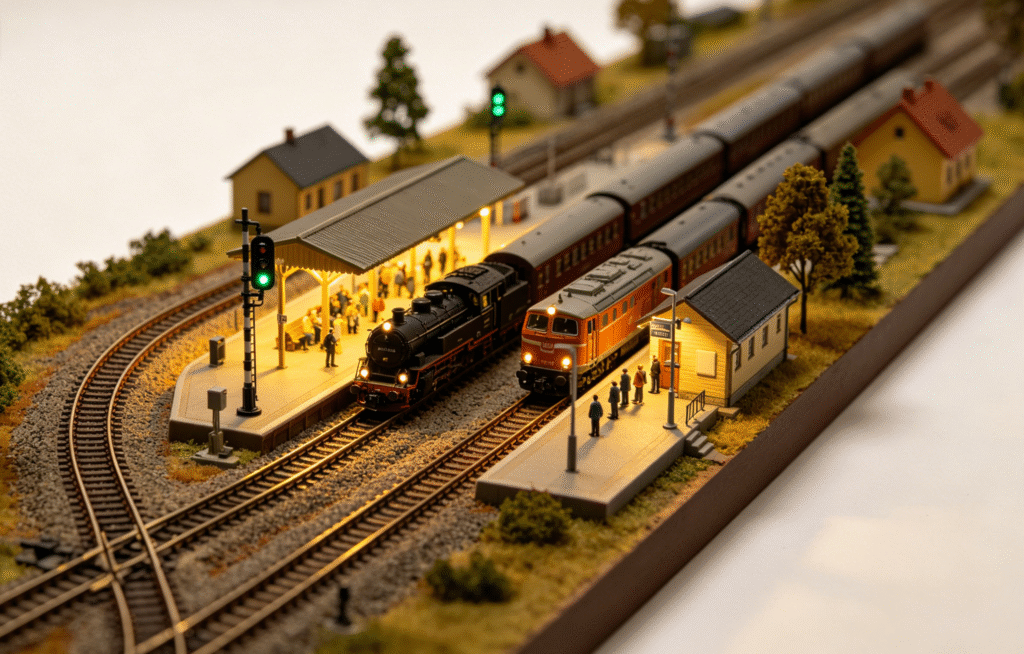
Passengers wait on the platform.
Your carriage arrives at a beautiful station.
Model Railroad Mountain Scene Customization Service
A mountain backdrop for your carriage.
Use Model Railroad Mountain Scene Customization Service once.
Snow caps and pine trees.
Your carriage climbs through a scenic pass.
Model Railway Crossing Custom Service
A crossing where your carriage passes.
Use Model Railway Crossing Custom Service once.
Gates lower as the train approaches.
Your carriage commands attention.
Custom Model Railroad Farm Scene Model
A farm scene along the route.
Use Custom Model Railroad Farm Scene Model once.
Cows and barns in the distance.
Your carriage rolls through the countryside.
Model Railroad City Scenery Custom Service
A city skyline behind the tracks.
Use Model Railroad City Scenery Custom Service once.
Skyscrapers and street lamps.
Your carriage arrives in the big city.
Choosing a Carriage Builder
Look at portfolios of past carriage work.
Read reviews from other collectors.
Ask about materials (brass, resin, wood).
Check if they do custom lettering and painting.
Get a written contract before starting.
Questions to Ask
What is your turnaround time?
Can you add interior lights and figures?
Do you include Kadee or Micro‑Trains couplers?
What happens if the carriage is damaged in shipping?
Do you offer design revisions?
What to Provide the Builder
Scale and exact length needed.
Photos of real carriages you like.
Paint scheme and railroad name.
Roof style (clerestory, arch, modern).
Any special features like a tail sign.
The Design Phase
The builder creates a 3D sketch or drawing.
You approve window placement and body color.
Changes are easiest at this stage.
Expect 2‑3 rounds of revisions.
Then construction begins.
Materials Used
Brass for durable, heavy carriages.
Resin for fine detail and light weight.
Wood for vintage or craftsman style.
Acrylic for window glazing.
Decals for lettering and numbers.
Building the Carriage
The body is cast or laser‑cut.
Sides, roof, and ends are assembled.
Window openings are cut cleanly.
Trucks and couplers are attached.
The carriage rolls smoothly.
Interior Details
Seats in period colors and fabrics.
Luggage racks and overhead lamps.
A lavatory in sleeping cars.
Tiny passengers reading newspapers.
Interior LEDs for night scenes.
Painting and Lettering
The body is primed and painted.
Colors match your railroad’s scheme.
Stripes and logos are masked and sprayed.
Custom decals with your train name.
A clear coat protects the finish.
Weathering the Carriage
Light dust on the roof.
Grime near the truck areas.
Window sills with slight wear.
Keep the body clean for passenger cars.
Your carriage looks gently used.
Lighting Installation
LEDs inside for warm glow.
Power from track pickups or battery.
A flicker circuit for oil lamps.
Lighted tail sign at the end.
Your carriage glows at night.
Testing on Your Layout
Run the carriage behind a locomotive.
Check for smooth tracking.
Test couplers with other cars.
Check interior lights on power.
Your carriage operates perfectly.
Displaying Your Carriage
Show it on a short display track.
A glass case protects from dust.
Run it in a special passenger train.
Show it at club meetings.
Enjoy your unique masterpiece.
Shipping Your Carriage
The builder packs in foam and a box.
Fragile details are wrapped separately.
Insure for full replacement value.
Open carefully and inspect.
Report damage within 48 hours.
Common Mistakes to Avoid
Not checking the builder’s past work.
Skipping a written contract.
Forgetting to specify coupler type.
Asking for major changes late.
Expecting a $150 carriage to be brass.
Final Tips
Start with one signature carriage.
Communicate clearly with your builder.
Be realistic about your budget.
Trust the expert’s design advice.
Your perfect carriage is waiting.
Now order your custom model train carriage today.
Include a depot miniature, mountain scene, crossing service, farm scene, and city scenery.
Let professionals build your passenger car.
Happy modeling.