



The 1:1 Precision Ship Model: A Masterpiece of Miniature Maritime World
The 1:1 precision ship model stands as a unique and revered artifact in the circles of ship enthusiasts, collectors, and maritime culture aficionados. More than a mere replica, it embodies the intersection of engineering precision, artistic craftsmanship, and historical preservation—capturing the essence of iconic vessels in every scaled detail. For collectors, it represents a tangible connection to maritime heritage; for enthusiasts, a testament to human ingenuity; and for cultural institutions, a powerful tool to educate and inspire. In this comprehensive guide, we will delve deep into the core definitions, rigorous standards, and multifaceted value of the 1:1 precision ship model, shedding light on what makes it a timeless treasure in the world of maritime art.
Unveiling the Mystery of the 1:1 Precision Ship Model
(I) Definition Breakdown
At its core, a 1:1 precision ship model refers to a scaled replica that adheres to an exact 1:1 ratio with the original vessel in terms of dimensions, external form, and structural details. Unlike standard models that often prioritize aesthetics over accuracy or simplify complex components, the 1:1 precision ship model is engineered to replicate the original ship’s every feature—from the curvature of the hull and the placement of portholes to the intricacy of rigging and the layout of the deck—with millimeter-level precision.
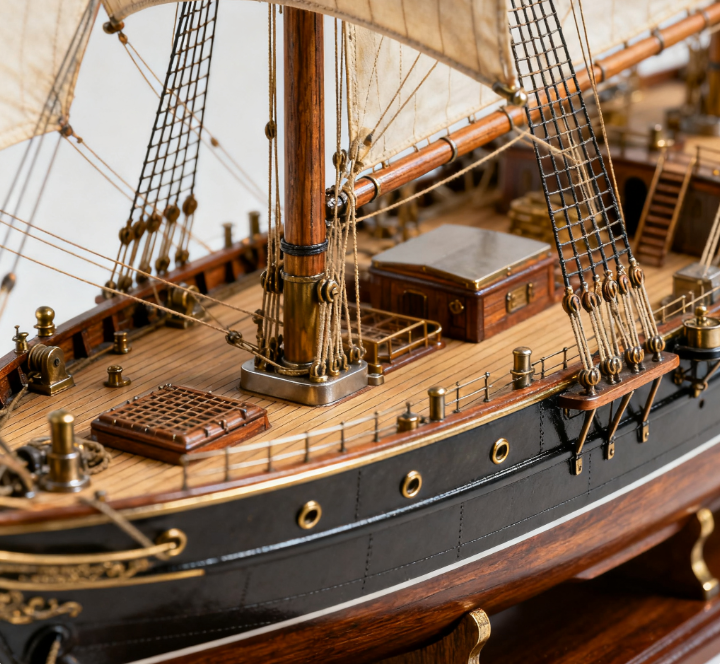
To clarify, the “1:1” ratio does not mean the model is the same size as the original ship (a common misconception). Instead, it denotes that every measurement of the model is a direct, proportional reflection of the original. For example, if a historical warship’s hull is 100 meters long, a 1:50 scale 1:1 precision ship model would be 2 meters long—with every subsequent detail (e.g., a 2-meter-tall mast on the original) scaled down proportionally (4 centimeters on the model). What sets this model apart from ordinary replicas is its uncompromising commitment to accuracy: no shortcuts are taken in replicating structural nuances, material textures, or even historical wear and tear.
Consider a standard mass-produced ship model versus a 1:1 precision ship model of the same vessel. The standard model might use generic plastic parts, simplify rigging into basic strings, and approximate the hull’s curve for cost efficiency. In contrast, the 1:1 precision ship model would use materials that mimic the original (e.g., imported walnut for the deck, brass for railings), feature individually tied rigging lines with historically accurate spacing, and replicate even minor details like chipped paint on the hull or engraved markings on cannons. This level of precision transforms the model from a decorative object into a functional “miniature twin” of the original ship.
(II) Historical Origins
The lineage of the 1:1 precision ship model traces back centuries, evolving from practical tools to artistic masterpieces. Its roots can be found in ancient civilizations, where sailors and shipbuilders crafted simple wooden replicas to plan vessel designs, communicate construction ideas, or document successful ships. These early models were rudimentary by modern standards—often lacking precise scaling—but laid the groundwork for the emphasis on accuracy that defines the 1:1 precision ship model today.
During the Age of Sail (15th to 19th centuries), ship models became critical for naval planning and maritime trade. European navies, including Britain’s Royal Navy and Spain’s Armada, commissioned detailed replicas to test ship designs before full-scale construction—a practice that saved time, resources, and lives. These models were crafted by master shipwrights, who used the same blueprints as the original vessels, ensuring that every beam, mast, and cannon was scaled perfectly. For example, the 18th-century French Navy’s model of the La Fayette frigate, now housed in the Musée national de la Marine in Paris, is a prime example of early precision: it features hand-carved wooden components, brass fittings, and even tiny replicas of the ship’s sails—all scaled to 1:48 with meticulous attention to detail.
The 19th and 20th centuries brought technological advancements that elevated the precision of ship models further. The invention of precise measuring tools (e.g., calipers, micrometers) and the standardization of blueprint drafting allowed craftsmen to replicate vessels with unprecedented accuracy. During World War II, military forces used 1:1 precision ship models to plan battles, train sailors, and study enemy vessels—with some models featuring removable parts to simulate damage or reveal internal systems.
In the post-war era, the 1:1 precision ship model shifted from a practical tool to a collectible art form. As maritime heritage gained cultural significance, collectors and museums sought out models that could preserve the memory of iconic ships—from the USS Constitution to the RMS Titanic. Modern craftsmen began blending traditional handcrafting techniques with cutting-edge technology (e.g., 3D scanning, CNC machining) to create models that are both historically accurate and artistically stunning. Today, the 1:1 precision ship model stands as a bridge between the past and present, honoring maritime history while pushing the boundaries of what is possible in miniature craftsmanship.
The Foundation of Quality: Material Selection for 1:1 Precision Ship Models
(I) Primary Materials
The choice of primary materials is critical to the durability, authenticity, and aesthetic appeal of a 1:1 precision ship model. Craftsmen select materials based on their ability to mimic the original vessel’s texture, strength, and appearance—ensuring that the model not only looks accurate but also stands the test of time.
Wood
Wood is the most traditional and widely used primary material for 1:1 precision ship models, particularly for replicas of historical wooden ships. Imported walnut, teak, and mahogany are preferred for their natural grain, durability, and ability to be carved and shaped with precision. Walnut, with its rich, dark tone and tight grain, is ideal for decking and hull components—it mimics the look of aged wood on historical vessels and ages beautifully over time. Teak, known for its resistance to moisture and warping, is often used for exterior parts like railings and masts, as it can withstand changes in humidity without losing its shape. Mahogany, with its warm reddish hue, is favored for decorative elements like figureheads and cabin panels, adding a touch of elegance to the model.
Metal
Metal plays a crucial role in replicating the structural and functional details of a ship. Brass and aluminum alloy are the most common choices, thanks to their malleability, corrosion resistance, and ability to be polished or aged to match the original vessel. Brass is used for railings, cannons, portholes, and hardware—its golden tone mimics the brass fittings on historical ships, and it can be patinated to create a weathered look. Aluminum alloy, which is lighter and more durable than brass, is often used for larger components like masts, hull frames, and propellers—particularly in replicas of modern ships or military vessels.
Resin
Resin has become increasingly popular in modern 1:1 precision ship model making, especially for replicating complex or delicate components. High-quality polyurethane resin is used to create hulls, cabins, and other large parts that require precise shaping—its ability to be cast in molds allows craftsmen to replicate intricate curves and details that would be difficult to achieve with wood or metal. Resin can also be painted or textured to mimic other materials, such as concrete (for modern ship hulls) or wood (for decorative panels), making it a versatile choice for mixed-material models.
(II) Detail Materials
While primary materials form the model’s structure, detail materials are what bring it to life—replicating the small, often overlooked features that make the original ship unique.
Rigging Materials
Rigging is one of the most complex and time-consuming aspects of 1:1 precision ship model making, and the choice of material is critical to achieving accuracy. Traditional rigging uses natural fibers like cotton or linen thread, which can be dyed to match the color of the original ship’s rigging and tied into historically accurate knots. For modern models, synthetic fibers like polyester or nylon are sometimes used—they are stronger and more resistant to fraying, but craftsmen often prefer natural fibers for their authenticity.
Sail Materials
Sails are another key detail that requires careful material selection. High-thread-count cotton or linen fabric is used to replicate the sails of historical ships—its natural drape and texture mimic the look of canvas sails, and it can be treated to look weathered (e.g., faded by the sun, stained by saltwater). For modern ships with synthetic sails, craftsmen use lightweight polyester fabric, which is stretched and shaped to replicate the tight, smooth appearance of modern sail materials.
Decorative Materials
Decorative details—such as flags, insignias, and engraved plaques—add personality and historical context to the 1:1 precision ship model. Flags are often made from silk or cotton fabric, printed or hand-painted with accurate designs (e.g., national flags, naval insignias). Engraved plaques, which typically display the ship’s name, launch date, or historical significance, are made from brass or aluminum and etched with precision tools to ensure legibility even at a small scale.
The Craftsmanship Code: Manufacturing Processes of 1:1 Precision Ship Models
(I) Traditional Handcrafting Techniques
Traditional handcrafting is the backbone of 1:1 precision ship model making, with many craftsmen still using techniques passed down through generations. These techniques require years of training and a steady hand—every cut, carve, and stitch is done manually, ensuring that each model is a unique work of art.
Hand Carving
Hand carving is used to create wooden components like hulls, masts, and figureheads. Craftsmen use a variety of tools—including chisels, knives, and gouges—to shape the wood, following detailed blueprints to ensure accuracy. For example, carving a figurehead for a historical warship requires not only precision in scaling but also an understanding of the original design’s artistic style—whether it’s a mythological creature, a national symbol, or a portrait of a historical figure.
Hand Joining and Assembly
Unlike mass-produced models that use glue or snap-fit parts, 1:1 precision ship models are often assembled using traditional joining techniques like dovetailing, mortise-and-tenon, or pegging. These techniques create strong, durable connections that mimic the way the original ship was built—ensuring that the model can withstand the test of time. Assembly is a slow, methodical process: each part is fitted to the next with meticulous care, and adjustments are made by hand to ensure a perfect fit.
Hand Painting and Finishing
Hand painting is the final step in traditional 1:1 precision ship model making, and it requires a high level of skill and attention to detail. Craftsmen use fine-tip brushes and airbrushes to apply paint in thin, even layers, matching the original ship’s color scheme down to the smallest detail. For historical models, this may involve researching historical records to find the exact shade of paint used (e.g., the gray of a WWII battleship or the red hull of a 19th-century merchant ship). After painting, the model is finished with a clear coat of varnish or wax to protect the paint and enhance the wood’s natural grain.
One iconic example of traditional handcrafted 1:1 precision ship models is the work of Italian craftsman Giovanni Panerai, whose replicas of 18th-century Mediterranean trading ships are celebrated for their accuracy and artistry. Panerai spends up to 2,000 hours on each model, hand carving every wooden component, tying each rigging line individually, and painting each detail by hand. His models are sought after by collectors worldwide, with some selling for hundreds of thousands of dollars.
(II) Modern Technological Assistance
While traditional techniques remain essential, modern technology has revolutionized 1:1 precision ship model making, allowing craftsmen to achieve levels of accuracy and complexity that were once impossible.
3D Scanning and Modeling
3D scanning is used to create digital replicas of original ships or existing models, providing craftsmen with precise measurements that can be used to guide the manufacturing process. For example, if a craftsman is replicating a rare historical ship that no longer exists, they can scan a museum’s scale model or historical blueprints to create a 3D digital model—this model can then be used to generate precise cutting patterns for wood or metal parts.
3D Printing
3D printing is ideal for creating complex or delicate components that are difficult to make by hand, such as engine parts, cockpit controls, or tiny deck fittings. Craftsmen use high-resolution 3D printers to produce parts from resin, plastic, or metal, following digital designs that are scaled to the model’s ratio. 3D printing allows for unprecedented precision—parts can be printed with tolerances as small as 0.1 millimeters, ensuring that they fit perfectly with other components.
CNC Machining
CNC (Computer Numerical Control) machining is used to cut and shape wood, metal, and resin parts with extreme precision. Unlike hand carving, which relies on the craftsman’s skill, CNC machining uses computer programs to guide the cutting tool—ensuring that each part is identical to the digital design. This technology is particularly useful for producing large quantities of identical parts (e.g., railings or portholes) or for creating complex shapes that would be time-consuming to cut by hand.
The fusion of traditional and modern techniques is what makes contemporary 1:1 precision ship models so remarkable. For example, a craftsman might use 3D scanning to create a digital model of a ship’s hull, CNC machining to cut the basic shape from wood, and then hand carve the details and hand paint the finish. This combination of old and new ensures that the model is both accurate and artistically authentic.
The Gold Standard: Evaluation Criteria for 1:1 Precision Ship Models
(I) Dimensional Accuracy
Dimensional accuracy is the most critical criterion for evaluating a 1:1 precision ship model—it is the foundation upon which all other aspects of the model’s quality are built. A model that fails to meet dimensional accuracy standards cannot be considered a true 1:1 precision replica, regardless of its aesthetic appeal.
Measurement Methods
To assess dimensional accuracy, experts use a variety of tools, including digital calipers, micrometers, laser measuring devices, and coordinate measuring machines (CMMs). These tools allow for precise measurements of every component of the model, from the length and width of the hull to the diameter of a cannon or the height of a mast. Measurements are compared to the original ship’s blueprints or historical records to ensure that the model adheres to the 1:1 scaling ratio.
Allowable Tolerances
While absolute perfection is impossible, 1:1 precision ship models are held to extremely tight tolerances—typically ±0.5 millimeters for small components and ±1 millimeter for larger parts. This means that a mast that should be 10 centimeters tall on the model can vary by no more than 0.5 millimeters (0.02 inches) from the target measurement. For historical models, these tolerances are even tighter, as any deviation from the original dimensions can compromise the model’s historical authenticity.
(II) External Form Similarity
External form similarity refers to how closely the model’s shape and silhouette match the original ship. This includes not only the overall curve of the hull but also details like the placement of portholes, the angle of the masts, the shape of the bow and stern, and the layout of the deck.
Evaluation Points
To evaluate external form similarity, experts compare the model to photographs, blueprints, and historical records of the original ship. Key evaluation points include:
- The curvature of the hull: Does it match the original’s lines, including the sheer (the upward curve of the deck) and the deadrise (the angle of the hull relative to the water)?
- The placement of features: Are portholes, hatches, and other openings located in the correct positions and spaced evenly?
- The silhouette: Does the model’s overall shape—when viewed from the front, side, or top—closely resemble the original ship?
For example, a 1:1 precision ship model of the USS Constitution must have the same distinctive rounded hull, three masts, and square-rigged sails as the original—any deviation in the hull’s curve or the mast’s angle would reduce its external form similarity.
(III) Structural Accuracy
Structural accuracy refers to how closely the model’s internal and external structure matches the original ship. This includes not only the visible components (e.g., rigging, railings) but also the hidden ones (e.g., hull frames, deck beams, internal compartments).
Internal Structure
While internal structure is not always visible, it is critical to the model’s durability and authenticity. For example, a model of a wooden ship should have internal frames and beams that mirror the original’s construction—even if they are hidden beneath the deck or hull. These internal components are often made from the same materials as the external parts, and they are assembled using the same traditional techniques to ensure structural integrity.
External Structure
External structural accuracy is more visible and includes details like rigging, railings, and deck fittings. Rigging must be tied in historically accurate knots, with lines spaced correctly and tensioned to mimic the way the original ship’s rigging would have looked under sail. Railings must be straight and evenly spaced, with posts that are scaled correctly to the model’s size. Deck fittings—such as cleats, winches, and hatches—must be placed in the correct positions and shaped to match the original’s design.
The Shining Light: Applications of 1:1 Precision Ship Models in Various Fields
(I) Collectible Value
The 1:1 precision ship model is highly sought after in the collector’s market, thanks to its rarity, craftsmanship, and historical significance. Collectors value these models not only for their beauty but also for their ability to preserve a piece of maritime history—each model tells a story, whether it’s the story of a famous battle, a groundbreaking ship design, or a bygone era of maritime trade.
Rarity and Exclusivity
Most 1:1 precision ship models are made in limited quantities—some craftsmen produce only a handful of models per year, and others create one-of-a-kind pieces for individual collectors. This rarity drives up their value, with some high-end models selling for tens or even hundreds of thousands of dollars at auctions. For example, a 1:48 scale 1:1 precision ship model of the RMS Titanic, crafted by British model maker Steve Mayo, sold for $120,000 at a 2022 auction—thanks to its meticulous attention to detail (including tiny replicas of the ship’s grand staircase and lifeboats) and historical accuracy.
Artistic and Historical Value
The 1:1 precision ship model is also valued as a work of art. Craftsmen spend hundreds or even thousands of hours on each model, combining technical skill with artistic vision to create pieces that are both accurate and visually stunning. Many collectors display their models in custom-built cases, treating them as centerpieces of their home or office decor. Additionally, these models have significant historical value—they serve as tangible records of ships that may have been destroyed, scrapped, or lost to time. For example, models of 19th-century whaling ships or early steamships are often used by historians to study the design and construction of these vessels, as few original examples remain.
(II) Educational Significance
The 1:1 precision ship model is a powerful educational tool, used in schools, museums, and maritime institutions to teach students and visitors about ship design, maritime history, and navigation.
School and University Education
In maritime academies and engineering schools, 1:1 precision ship models are used to teach students about ship hydrodynamics, structural engineering, and navigation. For example, a model of a modern cargo ship can be used to demonstrate how the hull’s shape affects speed and stability, while a model of a historical warship can help students understand the evolution of naval technology. The models allow students to interact with a physical representation of complex concepts, making learning more engaging and memorable.
Museum Exhibits
Museums around the world use 1:1 precision ship models to tell the story of maritime history. Exhibits often feature models alongside original artifacts, photographs, and historical documents—creating a immersive experience for visitors. For example, the Smithsonian’s National Museum of American History houses a 1:48 scale model of the USS Constitution, which is displayed alongside the ship’s original bell and a collection of historical weapons. The model helps visitors visualize the ship’s size and design, providing context for its role in American history.
Public Outreach and Education
Maritime organizations and museums also use 1:1 precision ship models for public outreach programs, such as workshops, lectures, and hands-on activities. For example, a museum might host a workshop where visitors learn to build a small-scale model of a historical ship, using simplified versions of the techniques used in 1:1 precision model making. These programs help to promote maritime culture and inspire the next generation of ship enthusiasts and historians.
(III) Exhibition and Display
The 1:1 precision ship model is a popular choice for exhibitions and displays, thanks to its visual appeal and ability to attract attention. Whether it’s a solo exhibition of a master craftsman’s work or a group display of models from different eras, these pieces never fail to impress.
Maritime Exhibitions
Maritime exhibitions around the world feature 1:1 precision ship models as centerpieces. For example, the annual Monaco Yacht Show includes a display of custom yacht models, many of which are 1:1 precision replicas of the world’s most luxurious yachts. These models allow potential buyers to see the yacht’s design and layout in detail before committing to a purchase. Similarly, naval exhibitions often feature models of military ships, from ancient galleons to modern aircraft carriers—showcasing the evolution of naval technology and strategy.
Corporate and Private Displays
Corporations, particularly those in the maritime industry (e.g., shipping companies, yacht builders, naval defense firms), often use 1:1 precision ship models as decorative elements in their offices, lobbies, and conference rooms. These models not only enhance the aesthetic appeal of the space but also serve as a symbol of the company’s heritage and expertise. For example, a shipping company might display a model of one of its first vessels, while a yacht builder might showcase a model of its latest luxury yacht. Private collectors also display their models in custom-built cases, often in dedicated rooms or libraries—creating a personal museum of maritime history.
Looking Ahead: The Future Blueprint of 1:1 Precision Ship Models
The 1:1 precision ship model has come a long way from its humble origins as a practical tool to its current status as a revered work of art and historical artifact. As we look to the future, several trends are likely to shape the development of these models—from material innovation and technological advancement to expanding applications and growing cultural significance.
Material Innovation
Advancements in materials science are likely to lead to new and improved materials for 1:1 precision ship model making. For example, the development of lightweight, high-strength composites could allow craftsmen to create larger models without sacrificing durability, while new types of biodegradable resins could make models more environmentally friendly. Additionally, the use of smart materials—such as materials that change color in response to light or temperature—could add new levels of interactivity to models, making them even more engaging for viewers.
Technological Advancement
Technology will continue to play a key role in the evolution of 1:1 precision ship model making. Improvements in 3D scanning and printing will allow craftsmen to create even more accurate and complex models, while advances in artificial intelligence (AI) could help automate some of the more time-consuming aspects of the process—such as generating blueprints or calculating scaling ratios. Virtual reality (VR) and augmented reality (AR) could also be integrated into models, allowing viewers to “step inside” the model and explore its internal structure or see it in action (e.g., sailing on a virtual sea).
Expanding Applications
The applications of 1:1 precision ship models are likely to expand beyond their current uses in 收藏,education, and exhibition. For example, they could be used in the film and television industry to create realistic props for maritime-themed movies and TV shows, or in the video game industry to design accurate ship models for naval combat games. Additionally, they could be used in architecture and urban planning to visualize maritime-themed developments, such as ports, marinas, and waterfront parks.
Growing Cultural Significance
As maritime heritage becomes increasingly important in a globalized world, the 1:1 precision ship model is likely to gain even more cultural significance. These models serve as a reminder of humanity’s connection to the sea—from the early explorers who crossed oceans in wooden ships to the modern sailors who navigate the world’s waterways in high-tech vessels. They are a celebration of human ingenuity, craftsmanship, and adventure—and they will continue to inspire and educate generations to come.
In conclusion, the 1:1 precision ship model is more than just a replica—it is a masterpiece of engineering, art, and history. From its detailed definitions and rigorous standards to its diverse applications and promising future, it embodies the best of what human creativity and precision can achieve. Whether you are a collector, an enthusiast, a student, or simply someone who appreciates beauty and craftsmanship, the 1:1 precision ship model is a timeless treasure that will continue to captivate and inspire for years to come.

Leave a Reply