



3D printed aircraft model customization: Embark on a journey of personalized flight exploration
When traditional models fail to meet the demand for replication of specific aircraft types, and when enthusiasts yearn for aircraft models with exclusive designs, 3D printed aircraft model customization emerges as the times require. Whether it’s classic fighter planes from World War II, modern civil aviation’s new passenger aircraft, or even futuristic flying machines from science fiction works, 3D printing technology can transform virtual designs into physical models, giving every passion for flight a unique carrier. At model enthusiasts’ gatherings, aviation-themed exhibitions, or personal collections, 3D printed aircraft model customization works always become the focus of attention with their precise details and exclusive designs, opening up a new dimension of personalized flight exploration.
II. 3D printing technology: empowering aircraft models with ultimate precision in customization
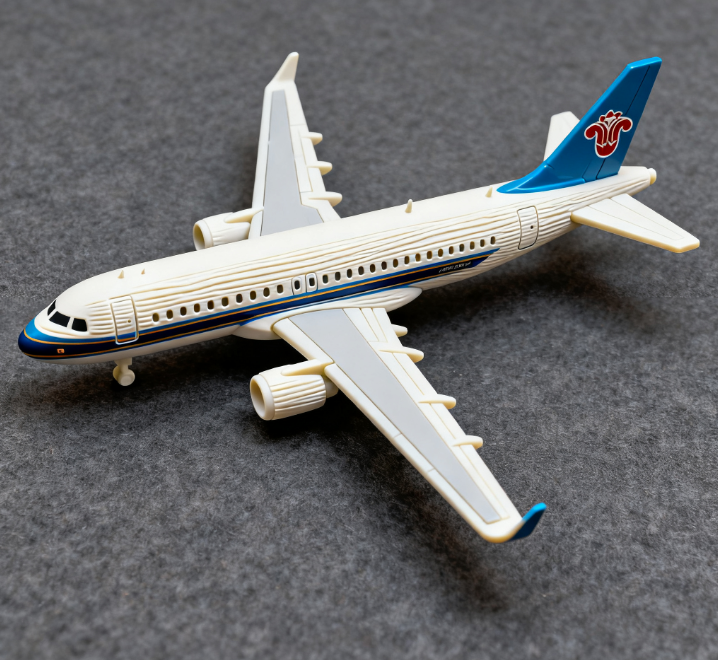
The core advantage of 3D printed aircraft model customization lies in the ultimate precision conferred by technology. Traditional model making relies on mold pressing, which is prone to errors in complex structures. However, 3D printing, through layered manufacturing, can perfectly reproduce every detail of an aircraft – from the curvature of the wings, the rivet texture of the fuselage, to the dashboard of the cockpit, the markings on the tail, and even the tiny parts of the landing gear, all can be accurately presented according to the original drawings or design scheme. Taking the replication of a certain vintage fighter as an example, after obtaining prototype data through 3D scanning technology, designers can refine every component in the computer, and then produce them through 3D printing processes such as Fused Deposition Modeling (FDM) or Stereolithography (SLA). The proportional error between the final product and the real aircraft can be controlled within 0.1 millimeters. This level of precision makes 3D printed aircraft model customization not only a collectible item, but also a “micro-teaching aid” for aviation knowledge popularization, helping people intuitively understand aircraft structures.
III. Full-process customized service: seamless connection from idea to model
3D printing aircraft model customization is not a single technical process, but a full-service offering encompassing “demand communication – design modeling – printing production – post-processing”. During the demand communication stage, the customizer can propose specific requirements: aircraft model selection, scale setting (such as 1:24, 1:48, etc.), detail annotations (such as specific painting, personalized lettering), and even functional additions (such as movable wings, built-in lights). The designer will use professional software (such as SolidWorks, Blender) to construct a 3D model based on the requirements and generate a preview image for the customizer’s confirmation. After confirmation, an appropriate 3D printer will be selected according to the material requirements of the model (such as ABS plastic, photosensitive resin, metal alloy) for production. After printing, the model will undergo post-processing procedures such as sanding, painting, and assembly to achieve a smooth and delicate surface and true color reproduction. This seamless service allows the customizer to own an exclusive 3D printed aircraft model without requiring any professional skills, simply by conveying their ideas.
IV. Diverse Application Scenarios: Value Extension of Customized 3D Printed Aircraft Models
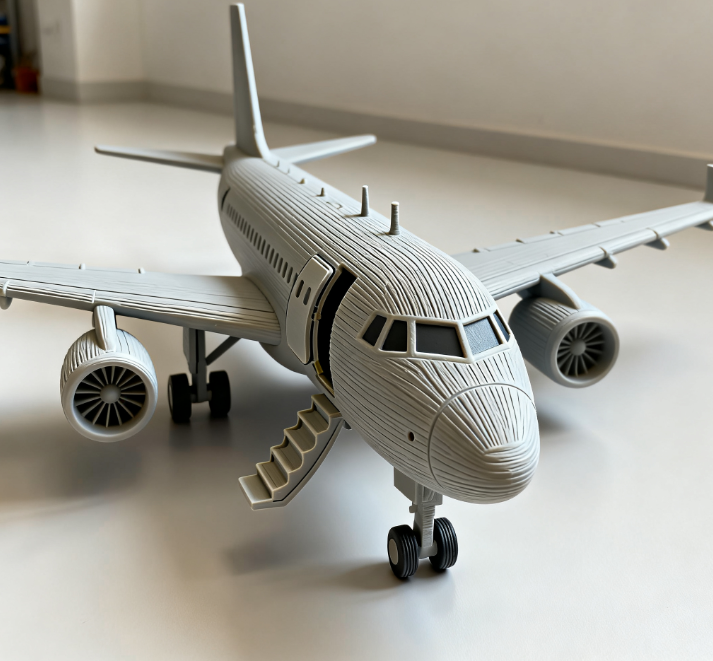
The application scenarios of 3D printed aircraft model customization are constantly expanding, far beyond the scope of personal collection. In aviation enterprises, it is used for appearance verification in new aircraft research and development – by creating 1:10 scale 3D printed models, designers can intuitively evaluate the aerodynamic layout of the fuselage, reducing research and development costs. In the field of education, schools customize 3D printed models of different aircraft types for students to disassemble and assemble themselves, deepening their understanding of aviation principles. In the cultural tourism industry, scenic spots or museums customize 3D printed models related to local aviation history as cultural and creative products or exhibition exhibits, conveying regional aviation culture. In addition, in fields such as military science popularization and film and television prop production, 3D printed aircraft model customization also plays an important role, serving as a link between technology, culture, and public demand.
V. Future Outlook: The Upgrade Direction of 3D Printed Aircraft Model Customization
With the iteration of 3D printing technology, the customization of 3D printed aircraft models will usher in more upgrades. On the one hand, the application of new materials will enhance the texture and durability of the models. For example, models made of carbon fiber composite materials are not only lightweight but also have stronger shock resistance. On the other hand, the integration of intelligent technology will optimize the customization experience. For instance, through AR (augmented reality) technology, 3D printed models can be combined with virtual scenes to simulate the flight process of an aircraft. Meanwhile, the gradual reduction in customization costs will also shift 3D printed aircraft model customization from a “niche demand” to “mass consumption”, allowing more people to realize their aviation dreams through customized models.
Whether it’s aviation enthusiasts, industry practitioners, or consumers seeking personalization, 3D printed aircraft model customization redefines the value of aircraft models with its precision, flexibility, and diversity. It is not only a combination of technology and art, but also a tangible expression of people’s love for flying, allowing every flying dream to land steadily through precise models.
Leave a Reply